Ask any teacher who has organised a school educational tour and they’ll tell you the same thing: the trip itself is the easy part. It’s the 6 weeks before departure that determines whether things go smoothly or fall apart.
This checklist is built from the practical reality of Indian school trip planning — the forms, the permissions, the parents who cancel last minute, the bus that breaks down. Every section here addresses a real problem, not a theoretical one.
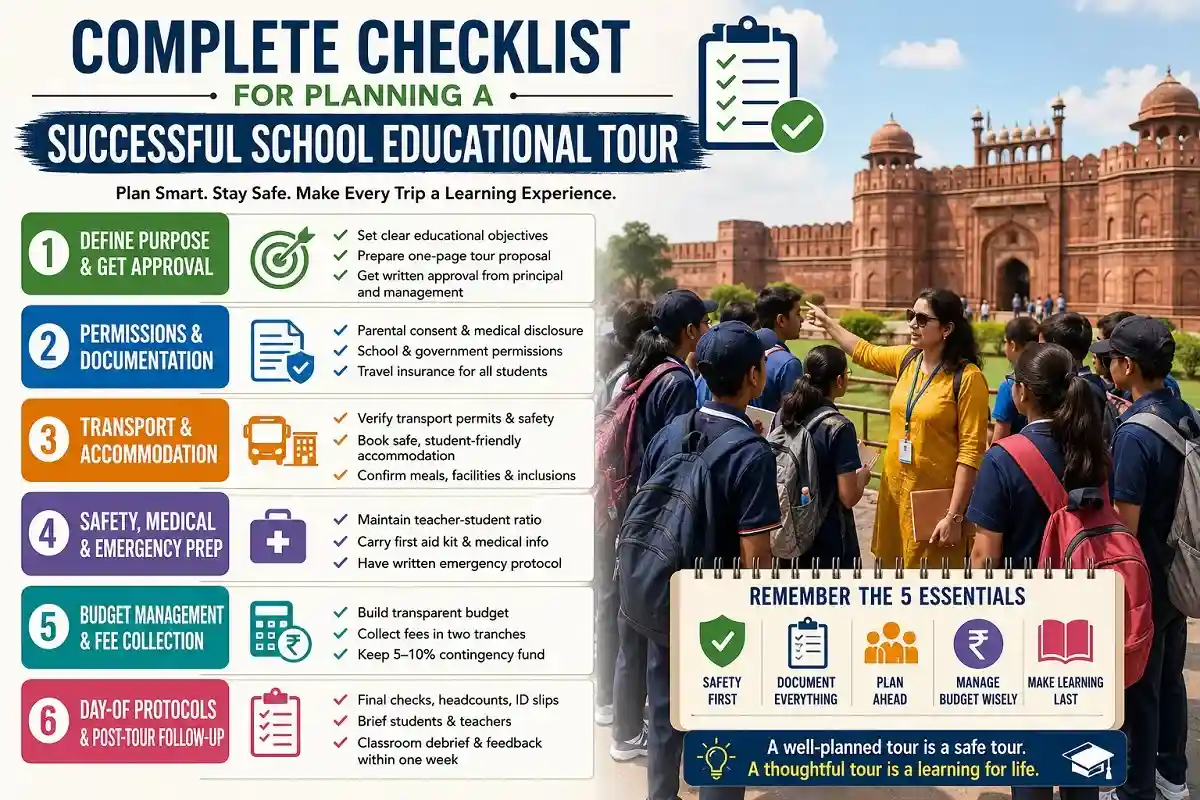
Quick Overview
A school educational tour checklist covers six stages: (1) educational objective and approval, (2) permissions and documentation, (3) transport and accommodation booking, (4) safety and medical prep, (5) budget management, and (6) day-of protocols. For most domestic school trips, you need 4–6 weeks of lead time. For inter-state or overnight tours, plan 6–8 weeks ahead.
Stage 1: Define the Purpose and Get Approval
Set a Clear Educational Objective First
A school educational excursion is not a holiday. Every trip should connect to a learning outcome — a geography lesson brought to life at a national park, a history unit grounded at a heritage monument, a science module experienced at a research museum. This clarity also makes it far easier to get management approval.
- Write a one-page tour proposal: destination, educational link, cost estimate, and risk assessment
- Get written approval from the principal and school management committee before announcing the trip to parents
- If your school is affiliated with CBSE, ICSE, or a state board, check their school excursion guidelines — some boards have specific requirements on trip frequency, distance, and student age
Choosing the Right Destination
The destination should match the age group, curriculum, and physical ability of the students. A trek to Kedarnath works for senior students; a science museum visit suits Classes 3–7. On the ground, what makes a destination ‘right’ comes down to safety, accessibility, and genuine learning value.
| Student Age | Recommended Tour Type | Example Destinations |
| Classes 1–4 | Local/city day trips | Science museum, zoo, botanical garden |
| Classes 5–7 | State-level overnight trips | Historical forts, wildlife sanctuaries |
| Classes 8–10 | Inter-state educational tours | Delhi monuments, ISRO Bengaluru, Rajasthan |
| Classes 11–12 | Specialized/industry visits | Research institutes, industrial plants, hill treks |
Stage 2: Permissions and Documentation
Parental Consent — the Right Way
A verbal ‘yes’ from a parent means nothing legally. Every student must bring back a signed consent letter. Design it clearly in both English and the local language. Include trip dates, destination, cost, emergency contact numbers, and a specific clause about medical conditions.
- Consent form must be signed by parent or legal guardian — not the student
- Include a medical disclosure section: allergies, chronic conditions, current medications
- Collect emergency contact numbers — at least two per student (parent + one alternate)
- Set a hard deadline for return of forms: 10 days before departure. Chase stragglers individually.
School and Government Permissions
Beyond parental consent, you likely need additional permissions depending on the trip type.
| Trip Type | Additional Permission Needed |
| City/local day trip | Principal approval + parent consent only |
| Overnight domestic trip | Management committee approval + police intimation letter (some states) |
| Inter-state trip | School board intimation + district education officer letter |
| Wildlife sanctuary / protected area | Forest Department entry permit for groups |
| International trip | Passports, student visa, travel insurance — start 10–12 weeks ahead |
Travel Insurance — Don’t Skip This
One mistake many schools make is treating travel insurance as optional. It isn’t. A group travel policy covering 30–40 students for 3 days costs roughly ₹1,000–₹2,000 total through providers like Bajaj Allianz, TATA AIG, or New India Assurance. For the cost per student (₹30–60), you get coverage for medical emergencies, accidental injury, and trip cancellation. If anything goes wrong — a student fractures an ankle, someone has an allergic reaction — you’ll be very glad you have it.
Stage 3: Transport and Accommodation
Choosing the Right Transport Mode
| Mode | Best For | Cost Per Student/Day (est. 2026) |
| School bus (own) | City/nearby trips under 100 km | ₹100–300 (fuel + driver) |
| Chartered private bus | Overnight inter-state trips | ₹400–900 |
| Train (group booking) | Budget trips, 300–1000 km | ₹180–450 (sleeper class) |
| Air travel | Distant or international tours | ₹3,500–9,000+ |
- Verify the operator’s school transport permit, vehicle fitness certificate, and driver’s commercial license
- For train travel: book group quota tickets at the railway reservation counter — minimum 10 passengers needed, at least 60 days in advance
- Always have a backup transport contact — what happens if the bus breaks down at 9 PM on a highway?
- Confirm bus capacity: 1 seat per student, no standing. Overcrowding is both illegal and dangerous on long trips
Booking Safe Accommodation
For overnight school tours, accommodation selection carries more responsibility than adult travel. You are responsible for 30–60 children away from home.
- First preference: government guesthouses (PWD rest houses, GMVN/KMVN properties), YMCA hostels, certified youth hostels under the Youth Hostel Association of India
- Mandatory: separate dormitories or rooms for boys and girls with lockable facilities
- Check: fire safety certificate, emergency exits clearly marked, fire extinguishers present
- Confirm: 24-hour water supply, functional toilets at ratio of at least 1 per 8 students
- Get a written quote that explicitly lists inclusions: meals, bedding, taxes, room type — verbal quotes lead to disputes
Stage 4: Safety, Medical and Emergency Prep
Teacher-to-Student Ratio
The recommended ratio for domestic school excursions is 1 supervising teacher per 10–15 students. For adventure activities, nature treks, or trips with Class 6 and below, reduce to 1:8. Co-ed trips must have at least one female teacher accompanying female students at all times — this is non-negotiable.
First Aid and Medical Readiness
- Carry a proper first aid kit: antiseptic cream, bandages, ORS sachets, paracetamol, antacids, antihistamine tablets, and safety pins
- Identify the nearest hospital or primary health centre at your destination before leaving
- Assign one teacher as the medical coordinator — this person holds all student medical forms and the first aid kit
- For students on regular medication (insulin, inhalers, EpiPen): keep a copy of prescription, carry spare doses, and brief at least two teachers on administration
- For hill or high-altitude trips: understand altitude sickness symptoms and have a plan to descend immediately if needed
Emergency Protocol — Write It Down
In a real emergency, people panic. A written protocol prevents that.
- Medical emergency: designated teacher administers first aid, calls nearest hospital, informs school admin, then parents — in that order
- Missing student: immediate headcount, split teachers to search, inform local police if not found within 20 minutes
- Natural event (flood/landslide): move to nearest safe building, call NDRF helpline (011-24363260), contact school admin
- Bus breakdown: keep students together, contact backup transport, inform school — never let students walk on highways
Share the written emergency protocol with all accompanying teachers before departure. Also send the tour itinerary with hotel address and teacher contact numbers to parents.
Stage 5: Budget Management and Fee Collection
Building a Transparent Budget
| Expense Category | Typical % of Total Budget |
| Transport (to/from + local travel) | 35–45% |
| Accommodation | 20–25% |
| Meals (all included) | 15–20% |
| Entry fees and activity costs | 10–15% |
| Travel insurance | 1–3% |
| Contingency fund (ALWAYS include) | 5–10% |
The contingency fund is not optional. Vehicle breakdowns, an extra meal stop due to delay, a student needing medical attention, an unexpected entry fee hike — these things happen. Without a buffer, you end up personally covering costs.
Fee Collection Strategy
Collect in two tranches: 50% at confirmation (2 weeks after announcement) and remaining 50% one week before the trip. This structure reduces last-minute dropouts, which inflate per-head costs for everyone else. Clearly state your refund policy in writing: typically, full refund up to 3 weeks before, 50% up to 1 week, no refund within 7 days.
Stage 6: Day-Before and Departure Day Checklist
The Night Before
- Call transport operator — confirm pickup time and vehicle
- Reconfirm accommodation — arrival time and meal arrangements
- Prepare master student list with name, emergency contact, medical notes — print 3 copies (one per senior teacher, one for bus, one for school admin)
- Collect all signed consent forms and medical forms — do a final count, not just a headcount
- Brief all accompanying teachers on roles: one for headcounts, one as medical coordinator, one for communication/logistics
- Charge all phones and power banks fully
Departure Morning
- Do a headcount before boarding and once everyone is seated
- Distribute student identity slips (name, school name, tour leader number) — laminated, to be kept on person
- Remind students of buddy system — everyone has a designated partner, they do not separate
- Check first aid kit is on board the vehicle
- Confirm teacher has list of students’ allergens / medical needs
Post-Tour: Making the Learning Stick
An educational tour without follow-up activities is a missed opportunity. The learning needs to be consolidated in the classroom within a week of return.
- Classroom debrief session: what did students observe, learn, or find surprising?
- Written assignment: a short report, creative essay, or photo journal
- Display board: photographs, student artwork, maps, and notes in the school corridor
- Feedback form for teachers and students: what worked, what to improve
- Send a brief post-trip note to parents summarising what was learned — builds trust and supports the next trip’s approval
Common Mistakes Schools Make on Educational Tours
- Announcing the trip before getting management approval — leads to awkward cancellations
- Not having a written emergency protocol — teachers freeze or take conflicting actions in a crisis
- Overcrowding the itinerary — 5 sites in one day exhausts students and reduces actual learning
- Collecting fees in full upfront — students drop out, cost redistributions cause resentment
- Booking unverified transport operators based on lowest price — vehicle fitness and driver licensing matter
- Skipping post-tour classroom activities — the learning evaporates within a week without reinforcement
Pro Tips for Smooth School Trip Planning
- Use a shared Google Sheet or WhatsApp group with teachers (not students/parents) to track consent forms, payment status, and medical flags — it saves enormous time
- Matching T-shirts for all students are worth every rupee — visual identification during headcounts and in crowded places is dramatically easier
- Build in one completely unstructured hour on longer trips — kids who have been ‘learning’ for 8 hours straight need a break, and so do teachers
- Partnering with a registered educational tour operator for complex trips (inter-state, adventure, or pilgrimage-based) transfers significant logistical burden — check their IATA or state tourism registration before signing
- Always carry printed copies of every document. Phone batteries die, internet fails in mountains — paper doesn’t
FAQs
How far in advance should I start planning a school educational tour?
For a simple local or city day trip, 3–4 weeks is manageable. For overnight inter-state tours, start 6–8 weeks out. For international trips or destinations requiring forest permits, begin 3 months ahead.
Is parental consent legally mandatory for school trips in India?
Yes. While there is no single national law specifying this, every school’s duty of care obligations under the Indian Contract Act and school affiliation guidelines require written parental consent for trips involving minors away from school premises. Without it, you have no legal protection if something goes wrong.
What is a safe teacher-to-student ratio for school excursions?
1:10 to 1:15 for general domestic trips. 1:8 for adventure activities or younger children. At least one female teacher must accompany female students on any overnight trip.
Which insurance providers offer group school travel policies in India?
Bajaj Allianz, TATA AIG, New India Assurance, and Oriental Insurance all offer group travel insurance for school trips. Costs are ₹30–80 per student for a 3-day domestic trip. Compare quotes before booking.
Are permission letters to police required for school trips?
It varies by state. Some states (like UP, Bihar, Maharashtra) require schools to submit a police intimation letter for inter-district or overnight trips. Contact your district education office to confirm local requirements.
What are the best educational tour destinations in India for school students?
Agra (Taj Mahal, Agra Fort — history), Delhi (Parliament, museums, science centre — civic and science), Bengaluru (ISRO, HAL museum, science parks), Rajasthan circuit (history, culture), Rishikesh–Haridwar (environment, culture), and Jim Corbett or Ranthambore (wildlife and ecology) are among the most popular for Indian school groups.
How do I handle students with food allergies on a school tour?
Collect allergy information on the medical consent form before the trip. Brief the medical coordinator teacher. Confirm with accommodation and meal providers in writing about allergen-free options. Carry antihistamine tablets and if any student has a severe allergy, ensure their EpiPen is accessible, not packed deep in luggage.
Can school tours happen during exam season?
Most schools avoid this for practical reasons, but there is no blanket prohibition. If a tour is scheduled near exam dates, get explicit written parent and management approval. Some school boards disallow trips in the 3 months before board examinations for Classes 10 and 12.
What should a school educational tour proposal include?
A good proposal covers: tour objective and curriculum link, proposed destination, travel dates, mode of transport, accommodation details, cost estimate per student, teacher-to-student ratio, safety plan, and how the tour will be followed up in class. One to two pages is sufficient.
How do I manage student discipline during a school trip?
Set non-negotiable ground rules in writing before departure and read them out on the bus. Use a buddy system. Assign teachers to specific student groups rather than ‘supervising generally.’ Structured activities reduce idle time and most discipline issues. Communicate consequences to parents and students upfront.
Ready to Plan Your Next School Educational Tour?
A well-organised school educational tour can be the most memorable learning experience of a student’s year — often the one they still talk about a decade later. The difference between a tour that goes smoothly and one that doesn’t is almost entirely in the preparation.
If logistics feel overwhelming — especially for complex inter-state or adventure-based trips — a registered educational tour operator handles permits, vehicles, accommodation, and site bookings while you focus on the students. Ask for itemised quotes and verify their track record with other schools before committing.
Suggested Tour