There’s a specific kind of silence that falls over a student when a tiger walks out of the treeline forty meters away. No teacher needs to explain ecosystem dynamics, predator-prey relationships, or habitat conservation in that moment. The lesson writes itself.
Wildlife educational tours for students are one of the most powerful forms of experiential learning available in India. And India, which hosts over 8% of the world’s total biodiversity within just 2.4% of the world’s land area, is genuinely one of the best countries on earth for this kind of education.
This guide covers the why, where, and how of wildlife tours for school and college groups — from choosing the right sanctuary to connecting every sighting to curriculum learning.
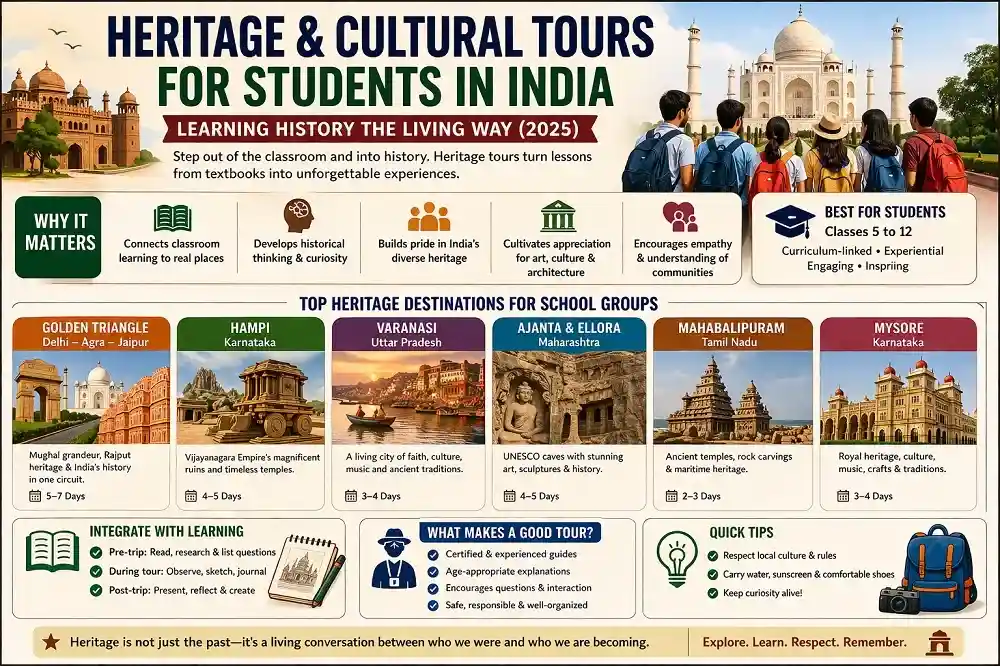
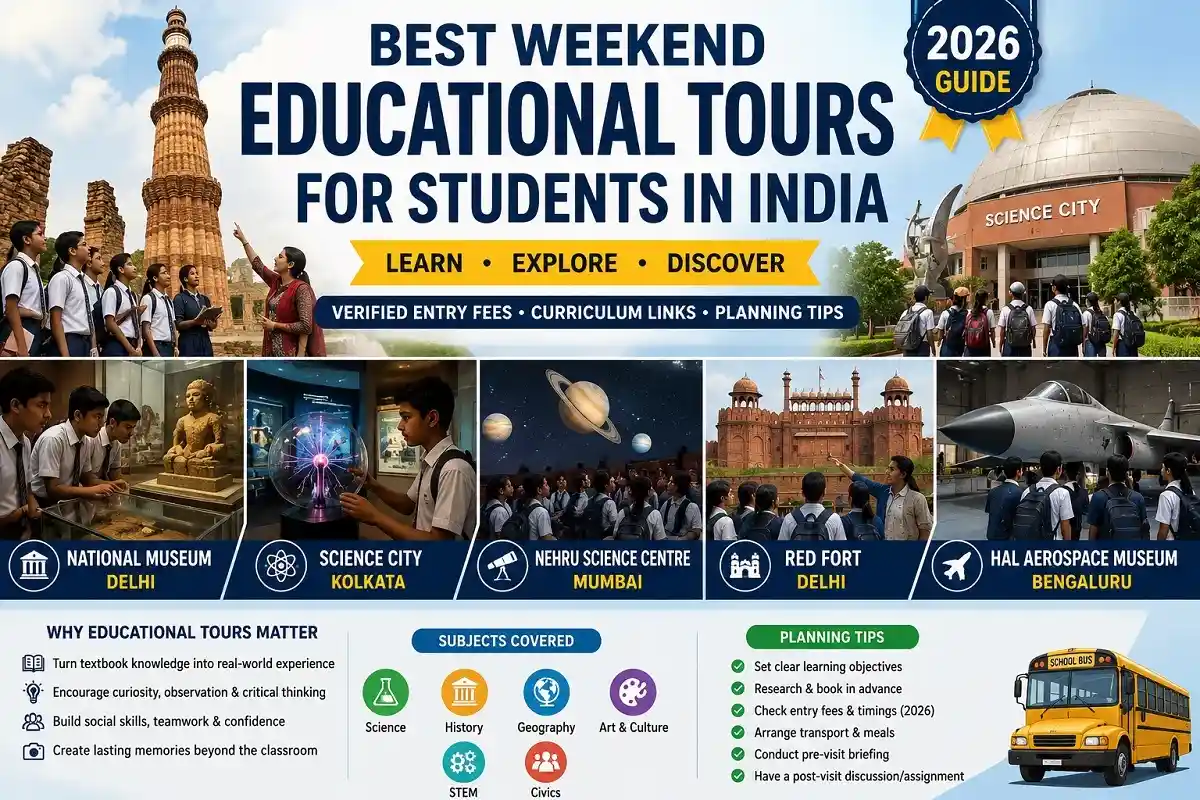
Why Wildlife Tours Belong in the Academic Calendar
Most students study ecosystems, food chains, endangered species, and conservation policy from textbooks. These are important concepts. But reading about a Bengal tiger’s territory size is a fundamentally different experience from watching a tigress walk through the dry teak forest she controls.
Wildlife educational tours develop several things simultaneously:
Scientific observation skills: Students learn to watch carefully — tracks, scat, territorial markings, animal behavior. These are real field biology skills.
Environmental empathy: It’s hard to be indifferent to wildlife conservation after you’ve spent three days in a forest with real animals. Students return with a personal stake in environmental policy.
Systems thinking: A wildlife sanctuary shows the web of life in action — how a drought affects grass cover, which affects herbivore health, which affects predator territory. Students see ecology as a living system, not a diagram.
Patience and observation: In a world of instant digital stimulus, waiting quietly in a jeep for an hour listening to jungle sounds is a form of mindfulness that students rarely access.
India’s Best Wildlife Destinations for School Groups
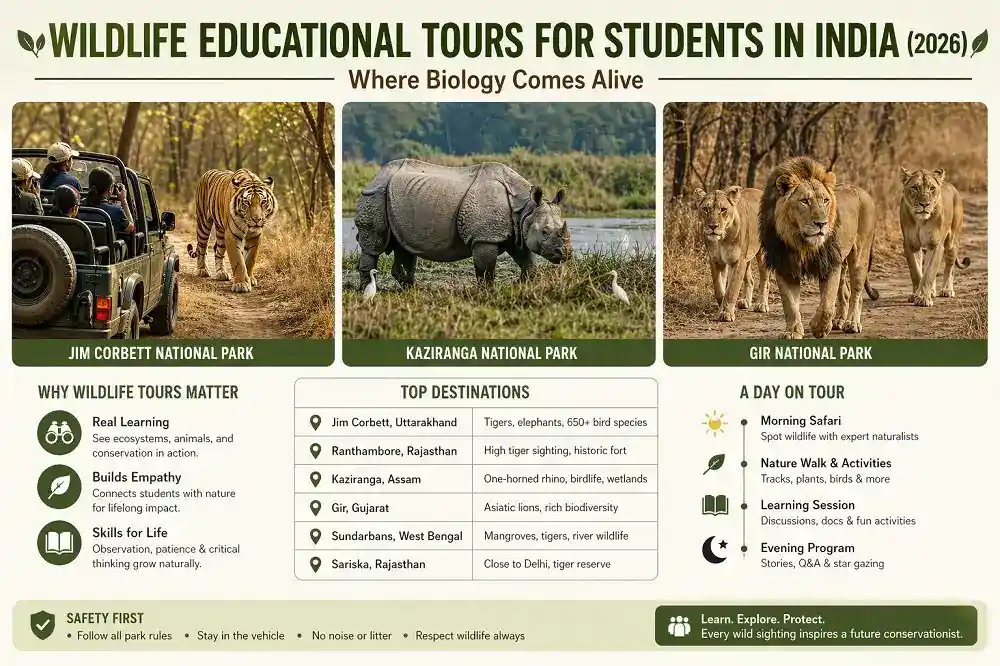
Jim Corbett National Park, Uttarakhand
India’s oldest national park, established in 1936, Jim Corbett is the gold standard for student wildlife tours from North India. Located in the Shivalik hills of Uttarakhand, it covers 1,318 sq km of dense forest, river valleys, and grasslands.
What students can see: Bengal tigers, Asian elephants, leopards, Gharial crocodiles, Himalayan black bears, and over 650 bird species — making it one of India’s most complete wildlife experiences.
Educational programs available: Several lodges and the forest department offer structured naturalist walks, track-reading sessions, and bird identification programs specifically designed for school groups.
Best season: November–June (park partially closes during monsoon) Best for: Schools from Delhi-NCR, Chandigarh, and nearby cities; Classes 6 and above
Ranthambore National Park, Rajasthan
Ranthambore is famous for one thing above all else: tigers. But it’s more than a tiger reserve. The ruins of the 10th-century Ranthambore Fort rise dramatically from the middle of the forest, creating a unique combination of wildlife and heritage in a single landscape.
Tiger sighting rates here are among the highest in India — which makes it excellent for student groups who need visible wildlife to maintain engagement.
What students learn here:
- Project Tiger and India’s conservation history
- How ancient human settlements coexisted with wildlife
- Camera trap methodology and monitoring techniques
- The relationship between tourism revenue and conservation funding
Best season: October–June Best for: All classes from 7 onwards; Rajasthan-based schools have an especially strong reason to visit this in-state resource
Kaziranga National Park, Assam
Kaziranga is not widely known among schools from mainland India, but it deserves to be. This UNESCO World Heritage Site on the banks of the Brahmaputra has the world’s largest population of the Indian one-horned rhinoceros — an animal that came perilously close to extinction and is now a conservation success story.
What makes Kaziranga special for students:
- The one-horned rhino conservation story — from less than 200 animals in the early 20th century to over 2,600 today — is one of history’s most inspiring wildlife recoveries
- Elephant safaris in addition to jeep safaris give a different perspective on the landscape
- Extensive water bodies with a huge variety of migratory birds
Best season: November–April Best for: Northeast India schools; science and conservation focus; Classes 8–12
Gir National Park, Gujarat
The last wild habitat of the Asiatic lion — and there’s no other place on earth to see this animal in the wild. Gir’s story is also one of conservation success: the lion population has grown from just 177 in 1968 to over 670 today.
Learning opportunities at Gir:
- The biology and behavior of Asiatic vs. African lions
- Maldhari tribal communities who live inside the sanctuary — the complex relationship between indigenous communities and conservation policy
- Deer, nilgai, sambar, and an extraordinary variety of raptors
Best season: December–April Best for: Gujarat schools, conservation policy discussions, Classes 8–12
Sundarbans, West Bengal
The world’s largest mangrove forest and a UNESCO World Heritage Site. The Sundarbans hosts the Bengal tiger, saltwater crocodile, Irrawaddy dolphin, and an extraordinary variety of marine and estuarine life. The landscape itself — low islands, tidal creeks, mangrove channels — is unlike anywhere else in India.
Educational value:
- Mangrove ecology and its role in coastal protection
- The unique adaptations of Sundarbans tigers (swimming tigers)
- Climate change vulnerability — Sundarbans islands are already disappearing due to sea level rise, making this a living lesson in climate impact
Best season: October–March Best for: West Bengal schools; climate change, marine biology, and ecology focus
Sariska Tiger Reserve, Rajasthan
Just 200 km from Delhi, Sariska is one of the most accessible tiger reserves for school groups from the capital. After locally extinct tigers were successfully reintroduced from Ranthambore, Sariska’s population is rebuilding. It also contains the ancient Pandupol Hanuman Temple inside the forest — a unique heritage-wildlife combination.
Best for: Short trips (2–3 days) from Delhi; Classes 6 and above
What a Wildlife Educational Tour Day Looks Like
Students often don’t know what to expect from a wildlife safari. Here’s a realistic picture:
Morning Safari (6:00 AM – 9:30 AM)
- Wake up before sunrise; temperatures are cool and animals are most active
- Jeep safari in small groups of 6–8 students per vehicle with a trained naturalist
- Naturalist points out animal tracks, territorial markings, fresh droppings
- Possible sightings: deer, monkeys, birds, and if lucky, larger predators or elephants
- Morning debrief: What did you see? What does it tell you?
Mid-Morning Activity (10:00 AM – 12:00 PM)
- Nature walk with the naturalist — plant identification, insect ecology, bird calls
- Track-identification activity or field journal session
- Expert session on conservation methods used in the reserve
Afternoon Session (2:00 PM – 5:00 PM)
- Optional: Second safari (some parks allow afternoon slots)
- Wildlife documentary screening with discussion
- Group activity: Ecosystem mapping or food chain construction exercise
Evening Activity
- Naturalist campfire session — stories from the forest, Q&A on animal behavior
- Star gazing (many reserves have minimal light pollution)
- Field journal entry
Connecting Wildlife Tours to the School Curriculum
| Curriculum Topic | Wildlife Tour Connection |
|---|---|
| Ecosystems & Food Chains | Direct observation of predator-prey relationships |
| Endangered Species | Conservation success stories — rhino, lion, tiger |
| Habitat and Adaptation | How different species adapt to forest, grassland, wetland |
| Human-Wildlife Conflict | Interview park staff about challenges |
| Conservation Policy | Project Tiger, Project Elephant — government action |
| Climate Change | Sundarbans sea-level rise, forest fire impact |
| Bird Migration | Migratory species visible at Bharatpur, Kaziranga |
Safety Guidelines for Wildlife Tours with Students
Wildlife sanctuaries have strict rules for good reasons. Ensure your operator briefed students thoroughly:
- Never stand up or exit the vehicle during a jungle safari
- No loud noise — it disturbs animals and reduces sighting opportunities
- No bright-colored clothing — nature colors only (khaki, olive, brown)
- No food outside designated areas — attracts animals to human zones
- Follow all forest department guidelines without exception
- No photography with flash near animals
Emphasize to students: you are a guest in an animal’s home. That framing changes behavior immediately.
Cost of Wildlife Educational Tours
| Destination | Duration | Approx Cost Per Student |
|---|---|---|
| Jim Corbett National Park | 3–4 days | ₹7,000–₹15,000 |
| Ranthambore National Park | 3–4 days | ₹8,000–₹16,000 |
| Gir National Park, Gujarat | 3–4 days | ₹9,000–₹15,000 |
| Kaziranga National Park | 5–6 days | ₹12,000–₹22,000 |
| Sundarbans, West Bengal | 3–4 days | ₹8,000–₹14,000 |
| Sariska Tiger Reserve | 2–3 days | ₹5,000–₹10,000 |
Safari fees, forest department permit charges, and naturalist fees are often separate from base tour costs — always ask for a fully itemized price.
FAQs: Wildlife Educational Tours for Students
Q-1: Is it safe to take students on wildlife safaris?
Yes — safari vehicles stay on designated tracks, rules are strictly enforced, and professional naturalists accompany every group. Wildlife encounters in sanctuaries are structured to minimize risk.
Q-2: What if students don’t see a tiger?
Guaranteed sightings are never possible with wild animals — and explaining this to students is itself a lesson in the unpredictability of nature. Even a safari without large predators will have bird sightings, herbivores, insects, and plant life that are educationally rich.
Q-3: What is the best wildlife park for a first student tour?
Jim Corbett or Ranthambore for North India; Bandipur or Nagarhole for South India. These have good infrastructure, experienced naturalists comfortable with school groups, and relatively high wildlife density.
Q-4: Can wildlife tours be combined with other educational themes?
Absolutely. Wildlife + heritage works beautifully in Ranthambore (Ranthambore Fort). Wildlife + adventure works in Jim Corbett (jungle treks, river activities nearby). Wildlife + tribal culture works in many Northeast destinations.
Q-5: Are there bird-watching tours for school groups?
Yes — Bharatpur Bird Sanctuary (Keoladeo Ghana), Chilika Lake in Odisha, and the Andaman Islands offer extraordinary bird-watching specifically designed for educational groups. India hosts over 1,300 bird species.
Q-6: What should students bring on a wildlife safari?
Binoculars (shared or personal), a field journal, a pen, sunscreen, a hat, water, and khaki/neutral-colored clothing. No perfumes or strongly scented products — these alert wildlife.
Q-7: Do wildlife reserves have educational programs specifically for schools?
Several do. Many tiger reserves have interpretation centres, trained naturalists, and forest department education officers who conduct structured programs for school groups. Ask your operator to arrange access to these resources.
Q-8: What age group benefits most from wildlife educational tours?
Classes 5 and above can benefit meaningfully. Younger children can participate in simpler programs at smaller wildlife parks or zoos with naturalist-guided sessions. High school students get the most value when the tour connects to biology and environmental science curriculum.
Q-9: Can photography be allowed during wildlife safaris?
Photography without flash is generally permitted and encouraged. Many students discover a genuine interest in wildlife photography on these trips — and photographers observe more carefully than passive viewers.
Q-10: Is Kaziranga accessible for schools from outside Northeast India?
Yes — direct flights to Guwahati from most major Indian cities, and then a 4-hour road journey to Kaziranga. For schools wanting a destination that’s unusual, richly rewarding, and paired with an introduction to Northeast India’s culture, it’s an outstanding choice.
Every wild animal a student sees in its natural habitat is a vote for conservation that lasts a lifetime. Wildlife educational tours don’t just teach ecology — they create environmentalists.
Suggested to Read: