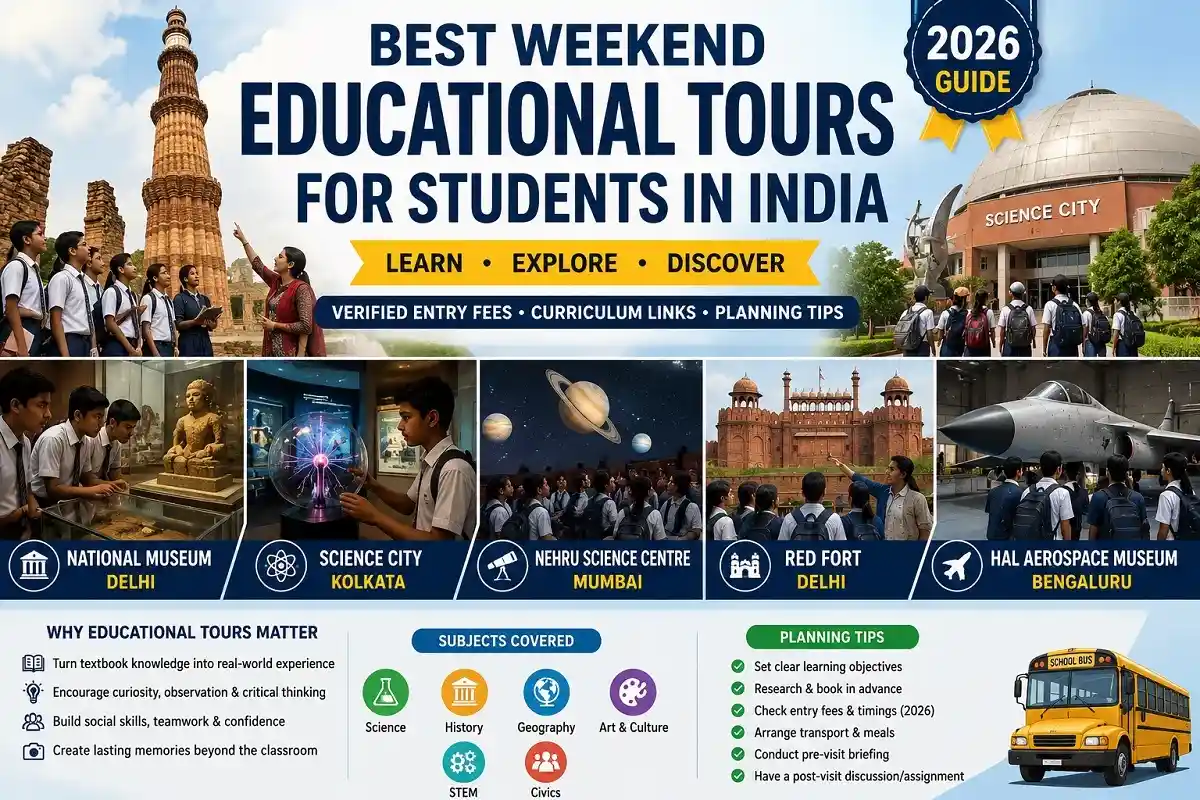
Weekend school trips often get treated as just a break from the classroom. The good ones are anything but. Standing inside a working 18th-century astronomical observatory, watching a 3D marine biology show, or walking through a fort where Mughal history actually happened — these moments convert textbook facts into memories that outlast exams.
This guide covers verified 2026 destinations, confirmed entry fees, curriculum links, and the planning steps that make the difference between a good trip and a genuinely educational one.
Why Educational Tours Work Better Than Classroom Learning Alone
The most effective field trips have three things in common:
- A clear learning objective tied to the current syllabus
- Active participation — touching, asking questions, observing in real space — not just following a guide
- A debrief afterward — a short discussion, worksheet, or assignment — that anchors what was seen
Trips that skip the pre-brief and debrief phases typically see low learning retention regardless of how impressive the venue is. That’s worth knowing before the planning starts.
Top Weekend Educational Tour Destinations: City by City
1. Delhi — India’s Most Versatile Educational Tour City
No Indian city packs more curriculum-relevant content into one weekend. Three UNESCO World Heritage Sites within 20 km. National institutions for science, history, art, and railway engineering. Most venues offer free or subsidised entry for school students.
Verified 2026 entry fees — Delhi school trip venues:
| Destination | Subject Area | School Entry Fee | Timings |
|---|---|---|---|
| National Museum | History, Art, Archaeology | Free (students up to Class 12 with ID) | 10 AM–6 PM, closed Mon |
| National Science Centre | STEM, Technology | Group rates (contact in advance) | 10 AM–5:30 PM, closed Mon |
| Nehru Planetarium | Astronomy, Space Science | Show-based, group rates available | Show schedule-dependent |
| Red Fort (UNESCO) | History, Architecture | ₹35 per Indian | All days, sunrise to 9 PM |
| Qutub Minar (UNESCO) | Medieval Architecture | ₹35 per Indian | Sunrise to sunset |
| National Rail Museum | Engineering, Transport History | ₹20–50 (child/student rates) | 10 AM–5 PM, closed Mon |
| National Crafts Museum | Art, Culture, Regional Craft | Group rates (advance request) | 10 AM–6 PM, closed Mon |
The National Museum is the most underused school trip venue in Delhi. Free entry for all students up to Class 12 (with valid school ID), 200,000+ artefacts, 21 galleries spanning 5,000 years — and most schools walk straight past it to the Taj Mahal instead.
Curriculum links: History (Class 7–10), Social Science, Physics, Astronomy, Art & Craft under CBSE/ICSE.
Ideal for: Class 5–12. A single Delhi weekend can cover 2–3 subjects if planned by learning objective, not geography.
2. Kolkata — Best City for STEM-Focused School Trips
Kolkata has Science City — the largest science centre in the Indian subcontinent, with over 29.9 million cumulative visitors since opening in 1997.
Science City, Kolkata — Verified 2026 Entry Fees:
| Visitor Category | Base Entry Fee |
|---|---|
| General visitors | ₹70 per person |
| Organised school groups | ₹35 per student |
| Government/aided school groups | Lower rates (confirm at counter with documents) |
| Underprivileged students (with documentation) | ₹5 per student |
Additional charges for shows and rides:
- 3D Show: ₹30 (school groups) | Dark Ride + Human Evolution combo: ₹45 | Cable Car: ₹40 | Science on Sphere: ₹20
Timings: 10 AM – 7 PM, all days of the week (ticket counters close at 6 PM). Entry is free for all visitors on International Museum Day (May 18) every year.
Science City’s sections include Space Odyssey, Dynamotion Hall, Earth Exploration Hall, Evolution Park, Maritime Centre, and an Emerging Technologies wing covering AI, robotics, and genomics. The Evolution of Life dark ride is particularly effective for Class 6–9 biology and earth science students.
Other Kolkata educational stops:
- Indian Museum — one of the oldest and largest museums in Asia; natural history, archaeology, and colonial-era collections
- Victoria Memorial — British Raj history, architecture, and document archives for Class 8–10
Curriculum links: Biology, Earth Science, Physics, History, Arts.
3. Mumbai — Interactive Science + Art History + Colonial Heritage
Mumbai offers three genuinely distinct educational experiences that don’t overlap with other cities.
Nehru Science Centre, Worli — Official School Package (2026): The school package is priced at ₹100 per student (₹85 for government/municipal/ZP school students). This includes a Science Odyssey show, a 3D science show on marine life, and a Science on Sphere session covering the solar system. Additional shows — Fun Physics, Earth Science — can be pre-booked for a nominal extra charge. The centre has 500+ hands-on interactive exhibits across 8 acres and is the Western Zone headquarters of the National Council of Science Museums (NCSM).
Advance booking is mandatory for the school package. Contact: nscm.edu@gmail.com with school letterhead before the visit date.
Timings: Tuesday to Sunday, 9:30 AM – 6 PM (closed Mondays and national holidays).
Other Mumbai stops:
- Chhatrapati Shivaji Maharaj Vastu Sangrahalaya (CSMVS) — art history, archaeological finds, colonial architecture; ideal for Class 9–12 humanities
- Nehru Planetarium, Worli — astronomy shows; schedule at nehru-centre.org
- Film City, Goregaon — media studies, storytelling, production; effective for commerce and creative students
Curriculum links: Physics, Chemistry, Biology, History, Media Studies, Art History.
4. Jaipur — Heritage Science + Architecture + Royal History
Jaipur is the only Indian city where students can study ancient astronomy through functional, physical instruments they can walk around and observe working in real-time.
Jantar Mantar, Jaipur (UNESCO World Heritage Site): Built by Maharaja Sawai Jai Singh II in the early 18th century, Jantar Mantar contains 19 astronomical instruments still accurate today. The Samrat Yantra — world’s largest stone sundial — measures solar time accurate to 2 seconds. This isn’t a museum with glass cases. Students walk between instruments, watch the shadow move, and understand how pre-telescope India tracked celestial bodies with stone and geometry.
Entry: ₹50 (Indians), ₹200 (foreigners); group rates available at the ticket counter.
Jaipur weekend circuit for students:
| Site | Subject Link | Entry (Indians) |
|---|---|---|
| Jantar Mantar (UNESCO) | Astronomy, Maths, Heritage Science | ₹50 |
| City Palace Museum | Rajput Governance, Art, Textiles | ₹100+ |
| Hawa Mahal | Architecture, Physics (natural ventilation) | ₹50 |
| Albert Hall Museum | Natural History, Art, Coins | ₹40 |
| Amber Fort | Military Architecture, Rajput History | ₹100 |
Curriculum links: History, Social Science, Physics (architecture and ventilation design), Ancient Indian Science, Art.
Ideal for: Class 6–12. Humanities and science students both find relevant material here — rare for a single city.
5. Bengaluru — Best STEM + Aerospace + Technology Weekend
Bengaluru is the natural choice for engineering, space science, and technology-focused school groups.
Visvesvaraya Industrial and Technological Museum (VITM): VITM is the Southern Zone headquarters of the National Council of Science Museums (NCSM), Government of India. Inaugurated by PM Jawaharlal Nehru on July 14, 1962, it attracts nearly one million visitors annually. The museum has 7 permanent galleries: Engine Hall, Fun Science, Electrotechnic, Space & Emerging Technology, Biotechnological Revolution, BEL Hall of Electronics, and Children’s Science.
2026 update: VITM revised its entry fees effective April 1, 2026. Verify current student/school group rates on the official website (vismuseum.gov.in) before booking, as the revised fee structure may differ from figures quoted by third-party sites.
Timings: All days, 9:30 AM – 6:00 PM (closed only on Deepavali and Ganesh Chaturthi).
Other Bengaluru educational stops:
- HAL Aerospace Museum — real aircraft including fighters and transport planes; one of the few places in India where students walk through actual aircraft. Ideal for Class 9–12 physics and engineering students.
- Jawaharlal Nehru Planetarium — astronomy shows and telescope sessions for Class 8–12.
- Lalbagh Botanical Garden — 240 acres; plant taxonomy, ecology, conservation biology for Class 6–10 science students.
Curriculum links: Physics, Biology, Computer Science, Engineering Basics, Astronomy.
6. Agra — History’s Most Effective Classroom
Agra gives students three UNESCO World Heritage Sites in one weekend. No other weekend trip in India covers Mughal history this comprehensively.
Agra student circuit:
| Site | Subject Link | Entry (Indians) |
|---|---|---|
| Taj Mahal (UNESCO) | Mughal history, Shahjahan, architecture | ₹50 |
| Agra Fort (UNESCO) | Military architecture, Mughal governance | ₹35 |
| Fatehpur Sikri (UNESCO, ~40 km) | Akbar’s capital, urban planning, Mughal religion | ₹35 |
| Agra Museum | Mughal artefacts, paintings, weapons | Minimal |
Students who study Akbar and Shahjahan in textbooks rarely see the physical evidence. This trip fixes that — and three sites at ₹120 total per student in entry fees is genuinely affordable.
Ideal for: Class 6–10 history students. Best combined with an overnight stay for 2-day pacing.
7. Ahmedabad — Civics, Constitution & Social Science
Ahmedabad offers something no other Indian city quite matches for civics and social science students: the Sabarmati Ashram — one of the most significant physical sites in modern Indian political history, where Gandhi lived and organised the 1930 Salt March.
Ahmedabad educational circuit:
- Sabarmati Ashram — Independence movement, civil disobedience, political philosophy; free entry; essential for Class 8–10 social science and civics
- Calico Museum of Textiles — one of the world’s finest textile collections; art, craft, trade history; advance booking required (strictly limited daily entry)
- Science City, Ahmedabad — interactive science park, IMAX, robotics gallery; useful for mixed groups
- Dada Hari Vav (Stepwell) — medieval architecture, water engineering, geometric design; connects mathematics and history simultaneously; minimal entry fee
Curriculum links: Civics, Indian Independence, Social Science, History, Geography, Art & Craft.
Subject-Wise Quick Reference: Best Destination Per Subject
| Subject | Best Weekend Destination | Top Venue |
|---|---|---|
| History (Mughal) | Agra | Taj Mahal + Agra Fort + Fatehpur Sikri |
| History (Modern/Independence) | Ahmedabad | Sabarmati Ashram |
| Astronomy / Heritage Science | Jaipur | Jantar Mantar (UNESCO) |
| STEM / Biology / Space | Kolkata | Science City |
| Physics / Engineering | Bengaluru | VITM + HAL Aerospace Museum |
| Art & Archaeology | Delhi | National Museum (free entry) |
| Marine Science | Mumbai | Nehru Science Centre (3D marine show) |
| Civics / Political History | Ahmedabad / Delhi | Sabarmati Ashram / National Archives |
| Ecology / Botany | Bengaluru | Lalbagh Botanical Garden |
| Architecture | Jaipur | Jantar Mantar + Hawa Mahal + Amber Fort |
How to Plan a Weekend Educational Tour: Step by Step
Step 1 — Start with the curriculum, not the destination. Identify what students are currently studying. A heritage trip timed 2–3 weeks before the Mughal history chapter lands far better than one planned randomly. The trip should answer a question students already have, not introduce one they haven’t formed yet.
Step 2 — Set one clear learning objective. “Students will visit Jaipur” is logistics. “Students will observe Jantar Mantar’s Samrat Yantra and explain how it measures solar time to two-second accuracy” is a learning objective. Students who arrive with a specific thing to find out engage far more actively.
Step 3 — Calculate the real cost per student. Hidden costs are where school trip budgets break down. Factor in:
- Entry fees at school/group rates (always lower than walk-in prices)
- Transport both ways — bus hire or train
- Meals — packed lunch vs. restaurant
- Guide fees if applicable
- 10% contingency reserve for unplanned costs
Step 4 — Get permissions and documentation right.
- School principal/management approval in writing
- Parent consent forms for all students
- Student medical information sheet
- Emergency contact list (not just on one person’s phone)
- Group travel insurance
Step 5 — Brief students before the trip. A 20-minute pre-trip session covering what they’ll see, what to look for, and one specific question to answer during the visit dramatically improves engagement. Students who arrive knowing what to observe learn more than those walking in cold.
Step 6 — Debrief after returning. A short follow-up — 10-question worksheet, class discussion, or “3 things I didn’t know before” — anchors the learning. Without this, most of what was seen fades within a week.
Cost Comparison: Weekend Educational Tour Budget Per Student
| Trip Type | Destination Example | Approx. Cost Per Student | Includes |
|---|---|---|---|
| City science museum (day trip) | Kolkata / Mumbai | ₹800–1,500 | Bus, entry, lunch |
| Heritage circuit (day trip) | Agra / Jaipur | ₹1,500–2,500 | Transport, 3 site entries, meals |
| Overnight weekend | Bengaluru / Ahmedabad | ₹2,500–4,500 | Bus/train, 1 night, meals, entries |
| Multi-city overnight | Delhi–Agra | ₹3,000–5,500 | Train, 5–6 entries, 1 hotel night |
These are budget-tier estimates for government and mid-range private schools. Always get at least 2–3 vendor quotes, confirm GST is included, and verify that school group entry rates — not general public rates — are being used in the calculation.
Common Mistakes Schools Make When Planning Educational Tours
- Trying to see too many sites in one weekend. Four heritage sites in two days = rushed visits where students absorb nothing. Two sites with enough time to explore and ask questions = genuine learning.
- Not booking group rates in advance. Science City Kolkata, Nehru Science Centre Mumbai, and the National Science Centre Delhi all have significantly lower school rates — but these often require an advance letter on school letterhead. Walking in without prior contact means paying general rates or sometimes being turned away.
- No curriculum connection. A trip with no link to current classwork is recreation, not education. That’s fine — but calling it an “educational tour” without the connection is a missed opportunity that’s also harder to justify to parents.
- Ignoring student-to-teacher ratios. Most institutional venues recommend 1 teacher or chaperone per 10–15 students for group visits. Some enforce it. Confirm before finalising headcount.
- One person holding all emergency contacts. If that person is separated from the group, the rest of the group is in trouble. Distribute printed emergency contact sheets to all accompanying adults.
Pro Tips for Teachers and Coordinators
- Contact venues 3–4 weeks in advance, not 3–4 days. Popular venues like Nehru Science Centre Mumbai and Science City Kolkata fill weekend school slots fast in July–September.
- Request the education officer or dedicated school program, not a general visitor tour. National Museum Delhi, VITM Bengaluru, and CSMVS Mumbai all have education teams who run structured student programs significantly better than regular visitor tours.
- Assign a specific observation task before entering. Even “find two things in this museum you’ve never seen in a textbook” transforms passive visitors into active observers.
- Check closure days before booking transport. Most major museums in Delhi are closed Mondays. Nehru Science Centre Mumbai is closed Mondays. The National Museum is closed Mondays and gazetted holidays. Missing this detail wastes the entire trip.
- Build the trip around one anchor experience, not a checklist. One deep visit to Jantar Mantar beats a surface-level rush through four Jaipur sites. Students remember depth, not quantity.
FAQs
What are the best weekend educational tour destinations for school students in India?
Delhi, Kolkata, Mumbai, Jaipur, Bengaluru, Agra, and Ahmedabad offer the strongest combination of curriculum-relevant content, school group infrastructure, and accessible entry fees. Delhi is the most versatile single city — covering history, science, art, and civics in one visit. Kolkata’s Science City is the best standalone science destination.
How much does a weekend educational tour cost per student?
A day-trip to a city science museum typically costs ₹800–1,500 per student including transport, group-rate entry, and a meal. An overnight heritage circuit (Agra or Jaipur) costs ₹1,500–2,500 per student at budget level. Multi-city overnight trips run ₹3,000–5,500 per student. These estimates use school group rates, not general public ticket prices.
Which science museum is best for school trips in India?
Science City Kolkata (largest in the subcontinent, school group entry ₹35), Nehru Science Centre Mumbai (school package ₹100 including three shows), and National Science Centre Delhi are the top three. Each has dedicated school programs requiring advance booking via school letterhead.
What is the entry fee for the National Museum Delhi for students?
Free — students up to Class 12 with a valid school ID card have free entry. Indian adults pay ₹20. The museum is open Tuesday to Sunday, 10 AM – 6 PM, and closed on Mondays and gazetted holidays.
Is Jantar Mantar Jaipur good for school students?
Very much so. Students can observe the Samrat Yantra (world’s largest stone sundial) actually measuring solar time in real-time — not a replica, not a model, but the functioning original built in the early 18th century. Entry is ₹50 for Indians. It directly connects to Class 6–10 maths, astronomy, and history — making it one of the highest curriculum-value sites per rupee in India.
Do students get discounted entry at heritage sites and museums?
Yes, at most government-run sites and ASI monuments. School group rates are considerably lower than general rates and usually require advance notice on school letterhead. The National Museum Delhi offers free student entry. Science City Kolkata charges ₹35 per student vs ₹70 for general visitors.
How far in advance should schools book educational tours?
3–4 weeks minimum for school group rates, guided program slots, and show bookings. For Nehru Science Centre Mumbai, advance email booking is mandatory for the school package. Last-minute bookings almost always result in paying general public rates or being denied group programming.
What documents are needed for a school educational tour?
Principal/management approval letter, parent consent forms for all students, student medical information sheet (especially for students with conditions or allergies), emergency contact list, group travel insurance, and confirmed itinerary. Most venues require a school letterhead letter to apply group/student ticket rates.
What subjects benefit most from educational tours?
History and social science see the most direct benefit from heritage tours. Physics, biology, and computer science benefit from interactive science museum visits. Geography from ecological field sites. Civics from Sabarmati Ashram or Parliament Museum visits. Art history from CSMVS Mumbai or National Museum Delhi.
What is the best educational tour for Class 5–7 students?
Science cities and interactive museums — Science City Kolkata, Nehru Science Centre Mumbai, National Science Centre Delhi. The combination of hands-on exhibits, 3D shows, and visual demonstrations suits this age group better than heritage-heavy sites requiring extended reading or sustained attention.
What is the best educational tour for Class 9–12 students?
Destinations with intellectual depth — Jantar Mantar Jaipur for heritage science, HAL Aerospace Museum Bengaluru for engineering, Sabarmati Ashram Ahmedabad for political philosophy, CSMVS Mumbai for art history, or Fatehpur Sikri for Mughal urban planning. These hold interest beyond a surface visit.
How do you make a school trip actually educational?
Three-step approach: brief students before departure with a specific question to answer during the visit, give them an observation task while there, and debrief with a short assignment or discussion when back. Trips that skip pre-brief and debrief retain far less learning regardless of how impressive the venue is.
Is VITM Bengaluru open on Sundays?
Yes — VITM is open all days from 9:30 AM to 6:00 PM, closing only on Deepavali and Ganesh Chaturthi. Entry fees were revised effective April 1, 2026; verify current school group rates at vismuseum.gov.in before planning the trip.
Conclusion
The best educational tour is the one that connects to what students are learning right now, keeps them actively doing rather than passively watching, and gives them something concrete to talk about weeks later.
For schools planning their first educational weekend, match the destination to the subject first. Delhi and Kolkata for science and history. Mumbai for technology and art. Jaipur for heritage science. Bengaluru for engineering. Agra for Mughal history. Ahmedabad for civics.
Book group rates in advance with a school letterhead letter. Brief students before the trip. Debrief when you return. The trip will be remembered and the learning will stick — which is exactly what makes the difference between a school outing and an educational tour.
Also Reads on: