Every teacher has faced it. The moment a concept clicks for a student — not in the classroom, but outside it. Standing in front of a historical monument, watching a manufacturing process in real time, or walking through an ecosystem they had only read about. That gap between classroom learning and real-world understanding is exactly where educational tours operate.
The debate between educational tours vs classroom learning is not really about which one replaces the other. It is about which combination creates students who actually retain knowledge, develop critical thinking, and carry skills into adult life. In 2026, with India’s NEP 2020 reforms actively mandating experiential learning in schools, and research from 2025 confirming measurable academic gains from study tours, this question has a clearer answer than it did a decade ago.
This guide covers everything — what current research says about learning outcomes, real costs, NEP 2020’s direct provisions, practical planning steps, and a direct comparison that helps parents, teachers, and school administrators make an informed decision.
Quick Overview
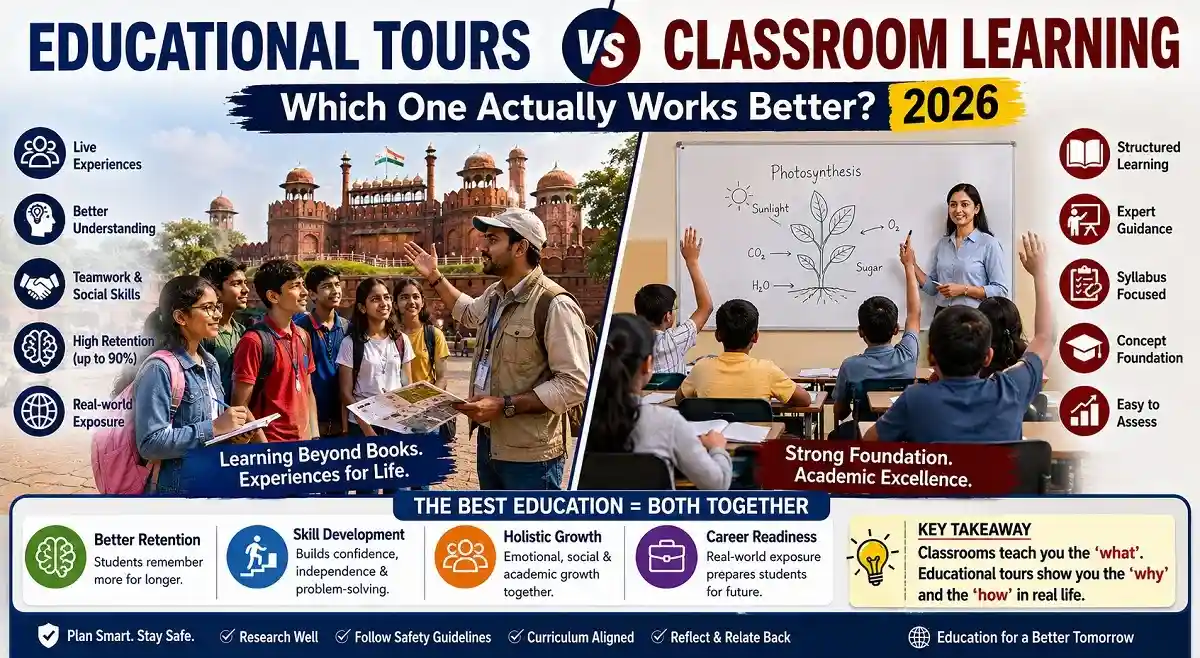
Both are necessary — but they serve different purposes. Classroom learning provides structured knowledge, theory, and curriculum foundation. Educational tours build retention, critical thinking, social skills, and real-world application. Active participation leads to significantly better retention and deeper understanding than passive lecture-based learning — a principle supported by research and reflected in India’s NEP 2020, which mandates experiential learning across all school stages. The most effective education uses both in combination.
What Is Classroom Learning?
Classroom learning refers to structured, teacher-led instruction delivered within a physical school environment. It follows a defined curriculum — textbooks, lessons, tests, and standardised assessments. In India, this typically maps to CBSE, ICSE, or State Board syllabi.
At its best, classroom learning is systematic. A trained teacher guides students through concepts in a logical sequence. Students build knowledge layer by layer. Weak areas can be identified through assessments and addressed quickly.
At its worst, it becomes passive. Students sit, listen, note, and memorise. India’s National Education Policy 2020, in Section 4.6, directly addresses this: it states that education must become ‘more experiential, holistic, integrated, inquiry-driven, discovery-oriented, learner-centred, discussion-based, flexible, and enjoyable’ — a clear signal that passive, rote-based classroom instruction is being formally phased out as the dominant method.
What Are Educational Tours?
An educational tour is a structured trip — to a heritage site, science institution, ecological zone, industrial facility, research lab, or cultural landmark — designed around specific learning objectives that align with a school’s curriculum.
The key word is structured. A well-planned educational tour is not a leisure trip with some educational branding. It has pre-tour preparation (students study the subject before visiting), guided engagement at the site, and post-tour activities — presentations, reports, discussions — that consolidate learning.
A 2025 study published in ScienceDirect described educational tours as enabling students to become ‘co-learners’ — actively constructing knowledge alongside teachers and peers — rather than passive recipients of information. The same study identified measurable outcomes across academic learning, psychological growth, and social responsibility.
Key Differences: Educational Tours vs Classroom Learning
| Factor | Classroom Learning | Educational Tours |
| Learning Style | Largely passive and theory-based | Active, hands-on, experiential |
| Retention | Drops sharply without reinforcement (Ebbinghaus: 70% lost within 24 hrs) | Significantly higher — active engagement slows forgetting curve |
| Curriculum Alignment | Directly mapped to syllabus | Most effective when designed around curriculum goals |
| Critical Thinking Development | Limited in lecture-only settings | Strong — real-world problems require it |
| Social Skill Building | Moderate (group projects, discussions) | High — teamwork, communication, independence |
| Cost | Part of school fees (low variable cost) | ₹300–₹2,50,000+ per student depending on type |
| Scalability | Reaches all students equally | Limited by budget, logistics, and accessibility |
| Teacher Control | High — structured environment | Moderate — depends on preparation quality |
| Emotional Engagement | Lower in passive lecture settings | Higher — memorable, sensory experiences |
| Cultural Awareness | Indirect — reading and discussion | Direct — immersive, first-hand exposure |
| Long-Term Memory | Lower for passively received content | Higher when tied to direct experience |
| NEP 2020 Alignment | Strong — curriculum delivery | Directly mandated in Section 4.6 and Bagless Days provision |
What Research Actually Shows About Learning Retention
One of the most widely circulated claims in education is that students retain 90% of what they learn by doing versus only 10% from a lecture. This figure comes from the ‘Learning Pyramid’ — a model attributed to the National Training Laboratories.
However, in 2026, educators and researchers should know the full picture: the exact percentages in the Learning Pyramid have no verified peer-reviewed source. The original data was never published, and the specific numbers cannot be traced to a controlled scientific study. A 2026 review by Arlo (a learning management platform) confirmed: ‘The exact retention percentages are not scientifically validated. The original research was never fully published and the underlying data and methodology are no longer available.’
⚠ Fact Check: Important Note: The core principle is well-supported — active learning leads to significantly better retention than passive lecture-based instruction. This is backed by decades of cognitive science research. But the specific ‘90% vs 10%’ numbers should not be cited as fact. They originate from an unverified model.
What Is Verified: Ebbinghaus Forgetting Curve
Hermann Ebbinghaus’s foundational research on memory decay — replicated in a 2015 PLOS One study — shows that without reinforcement, people forget approximately 40% of new information within 20 minutes, 55% within one hour, and about 70% within 24 hours. By the end of a month, only a small fraction of passively received information is retained.
This ‘forgetting curve’ applies to passive, non-contextual learning. The consistent finding across cognitive science is that emotional engagement, sensory experience, and active retrieval significantly slow the forgetting curve — all of which educational tours provide.
What 2025–2026 Research Confirms
- A 2025 mixed-method study on field trips in post-primary education (reviewed on Research.com) found that participants reported significantly higher engagement, motivation, and connection to real-world learning contexts when instruction extended beyond the classroom.
- A 2025 ScienceDirect study on study tours concluded they are ‘an effective extension and enhancement of classroom teaching and learning’ — particularly in building intercultural understanding, personal growth, and academic application.
- Research by Montgomery and Millenbah confirms that students who learn in outdoor and real-world settings significantly outperform those who learn only indoors during the initial learning phase.
- A 2025–2026 compilation of experiential learning outcomes reported that 78% of students in experiential programs showed improved critical thinking versus traditional lecture settings, and problem-solving ability improved by 65% in STEM subjects across a meta-analysis of 20 studies.
The practical takeaway is this: classroom and tour work best as a system. Pre-tour classroom preparation gives students the context to understand what they are seeing. The tour itself creates emotional and sensory anchors for that knowledge. Post-tour consolidation locks it in. Each stage makes the others more effective.
NEP 2020 and Educational Tours: What the Policy Actually Mandates
India’s National Education Policy 2020 is one of the clearest government endorsements of experiential, outdoor learning in Indian education history.
Section 4.6 — Experiential Learning Mandate
NEP 2020, Section 4.6, states directly: ‘In all stages, experiential learning will be adopted, including hands-on learning, arts-integrated and sports-integrated education, story-telling-based pedagogy, among others, as standard pedagogy within each subject.’ This is not a suggestion — it is policy for all schools following the NEP framework.
Bagless Days Provision
NEP 2020 also introduces ‘Bagless Days’ — a provision requiring schools to designate a set number of days per year for outdoor, vocational, and field-based learning, beginning from Class 6 onwards. Students spend these days at local workplaces, heritage sites, farms, or community organisations. This is a direct mandate for structured educational tours within the academic calendar.
What This Means for Schools in 2026
Schools affiliated with NEP 2020 are not treating educational tours as optional extras or rewards. They are a mandated part of the academic programme. For parents and administrators, this means educational tours in 2026 are not just educationally beneficial — they are a policy requirement for schools implementing NEP 2020 reforms.
NEP 2020 Section 4.6 (direct quote from policy document): ‘In all stages, experiential learning will be adopted, including hands-on learning, arts-integrated and sports-integrated education, story-telling-based pedagogy, among others, as standard pedagogy within each subject, and with explorations of relations among different subjects.’
Benefits of Educational Tours: What They Actually Develop
1. Real-World Application of Classroom Concepts
A student who has read about Mughal architecture in a textbook understands it at surface level. The same student who walks through Humayun’s Tomb, observes the construction techniques, discusses the historical context with a guide, and sketches the geometry of the dome has understood it at an entirely different depth. The concept has moved from abstract to experiential.
This matters especially in science and geography. Visiting a watershed management project to understand the water cycle, attending ISRO’s Vikram Sarabhai Space Exhibition in Bengaluru to understand space technology, or touring a water treatment plant — these experiences anchor textbook concepts to reality in ways that no classroom session can replicate.
2. Critical Thinking and Problem-Solving
In a classroom, the answers are generally in the back of the textbook. On an educational tour, students encounter real situations with no single correct answer. Why was this fort built at this location and not two kilometres away? What does the soil composition of this riverbank tell us about seasonal flooding? How does this museum decide what to preserve and what to leave out?
Working through these questions — in groups, under guidance, in real environments — is how critical thinking develops. Research from Wake Forest University’s Instructional Technology Group confirms that experiential learning ‘promotes critical thinking, decision making, and problem solving’ more effectively than classroom-only instruction.
3. Social and Emotional Development
Educational tours — particularly overnight trips — place students in situations where they must cooperate, resolve disagreements, and function as a team outside the usual classroom hierarchy. Students who are quiet or withdrawn in class often engage much more actively in field settings. The 2025 ScienceDirect study specifically identified psychological growth and social responsibility as key measurable outcomes from study tours.
4. Cultural Awareness and Empathy
India’s geographic and cultural diversity makes it uniquely valuable for educational tours. Students from Delhi visiting rural Maharashtra, or those from urban Tamil Nadu experiencing the cultural heritage of Assam, do not just read about India — they understand it. This exposure cannot be replicated through a classroom session or a documentary.
5. Long-Term Memory Through Emotional and Sensory Experience
Ask any adult what they remember from Class 8. Most will struggle to name a specific lesson. But almost everyone remembers a school trip vividly. Cognitive science consistently shows that memory is strengthened when it is tied to emotional and sensory experience — which is exactly what educational tours provide. The content does not just become information; it becomes an experience.
Limitations of Educational Tours: What to Watch Out For
Educational tours are not automatically effective. One of the most common mistakes schools make is treating a tour as a reward activity rather than a planned academic one. When that happens, the educational value drops significantly.
- Cost is the most significant barrier. Students from lower-income families may be excluded from expensive tours, creating inequality within a classroom community.
- Without structured pre-tour preparation and post-tour consolidation, the trip becomes a leisure outing with little lasting academic impact.
- Logistics — transport, accommodation, safety permissions, group insurance, supervision ratios — are complex. A poorly managed tour can be unsafe or counterproductive.
- Schools in remote or rural areas face genuine access constraints to quality tour destinations, reducing practical applicability.
- Measuring learning outcomes from tours is harder than marking a test — though structured reflection assignments and post-tour discussions make it possible.
Limitations of Classroom Learning: The Real Constraints
Classroom learning has served education systems for generations — and remains the foundation of structured academic delivery. But its limitations in the Indian context are well-documented.
- Over-reliance on rote learning: NEP 2020 directly addresses this as a systemic concern. Students memorise for exams and forget within weeks — consistent with the Ebbinghaus forgetting curve for passively received, non-contextualised information.
- Passive engagement: Traditional lecture-based teaching positions the teacher as the sole knowledge source, limiting student initiative and reducing the depth of learning.
- Limited real-world application: Concepts taught in isolation from real-world context are harder to apply. A student may understand photosynthesis from a textbook but struggle to explain what they observe in an actual ecosystem.
- One-size-fits-all delivery: Classrooms typically teach to the average student — which means both struggling students and advanced learners are underserved.
- Overcrowding: Many Indian classrooms have 40–60+ students, making active learning methods difficult to implement consistently.
Educational Tour Cost Breakdown: India 2026
Cost is the most practical concern for schools and parents. Here is a verified, realistic picture across different tour types for 2026:
| Tour Type | Typical Cost Per Student | Duration | Example Destinations |
| Local Day Trip (museum, science centre, heritage) | ₹300–₹800 | 1 day | Nehru Planetarium, National Museum, local ASI site |
| Regional Overnight Trip (domestic) | ₹2,500–₹8,000 | 2–3 days | Agra, Ranthambhore, Mysore, Ajanta-Ellora |
| Multi-Day Domestic Cultural Tour | ₹8,000–₹25,000 | 4–7 days | Delhi–Agra–Jaipur heritage circuit |
| Specialised Academic Tour (STEM / ecology) | ₹5,000–₹20,000 | 2–5 days | ISRO Bengaluru, Sundarbans, Western Ghats field study |
| International Tour (Asia — Singapore, Dubai) | ₹60,000–₹1,20,000 | 5–7 days | Science museums, cultural institutions |
| International Tour (Europe / UK) | ₹1,50,000–₹2,50,000+ | 8–14 days | Historical and cultural study tours |
Domestic day trips and regional overnight tours are the most accessible option for most Indian schools. The ₹2,500–₹8,000 range for a 2–3 day trip is within reach for middle-income families with advance planning and group discounts.
ℹ Info: ASI Ticket Rates 2026: Indian citizens pay ₹15–₹40 for most ASI-protected monuments. Children under 15 years enter FREE at most ASI sites. Many science centres, planetariums, and national parks also offer subsidised group rates for school bookings made in advance. The cost barrier is often lower than assumed.
Types of Educational Tours: Choosing the Right One
| Tour Type | Learning Focus | Best Class | India Examples |
| Heritage / Historical | History, architecture, political science | Class 6–12 | Hampi, Agra, Ellora, Qutub Minar, Sanchi, Maratha forts |
| Science / Technology | Physics, chemistry, STEM, space | Class 8–12 | ISRO Bengaluru, DRDO, Nehru Planetarium, TIFR Mumbai |
| Ecology / Environmental | Biology, geography, sustainability | Class 5–10 | Sundarbans, Western Ghats, Corbett, Rann of Kutch |
| Industrial / Vocational | Commerce, engineering, applied science | Class 10–12 | Auto plants, pharma factories, renewable energy sites |
| Cultural Exchange | Social studies, diversity, empathy | Class 7–12 | North-East India, Ladakh, tribal heritage zones, Rajasthan craft clusters |
| Agriculture / Rural | Geography, economics, life sciences | Class 5–9 | Baramati Agri Tourism, rural Maharashtra, Punjab farm visits |
| Bagless Day Visits (NEP 2020) | Cross-curricular, vocational, community | Class 6 onwards | Local workplaces, artisan clusters, community organisations, farms |
| International Study Tour | Global perspectives, cross-culture | Class 9–12 | Singapore, UK, Bhutan, Nepal, France — subject-specific tours |
How to Plan an Effective Educational Tour: Step-by-Step
The difference between a tour that delivers real learning and one that becomes just a day out lies entirely in preparation and follow-through. Here is the process that works:
- Define the learning objective first. Not ‘learn about history’ — but ‘understand how Mughal administrative systems worked by visiting Fatehpur Sikri and linking it to Chapter 4 of the Class 7 history textbook.’
- Choose the destination based on curriculum alignment. A visit to Bangalore’s Visvesvaraya Industrial and Technological Museum works for Class 8–10 technology students. A Sundarbans ecology field study works for Class 7–9 geography and biology.
- Prepare students in class before the tour. Run a 2–3 session module on the topic first. Give students a structured question worksheet to complete during the visit. Students who arrive with context learn significantly more than those arriving without preparation.
- Brief all teachers and chaperones. Assign specific supervision groups (recommended: one teacher per 15–20 students for off-campus trips). Share emergency contacts, medical information, and meeting-point protocols in writing before departure.
- Book in advance. Most heritage sites (ASI properties), science institutions, and ecological reserves require advance group booking. Guided tours, workshop slots, and accommodation fill up quickly during the October–February school season. ASI group bookings should be made at least 2–3 weeks ahead.
- Engage actively during the tour. Use the question worksheet. Let students observe, ask, sketch, record, and discuss. Avoid rushing through multiple sites. Depth at one location is more valuable than briefly visiting five.
- Consolidate within one week of return. A short written report, group presentation, or structured class discussion that links what was seen to the textbook content. This post-tour step is the most frequently skipped — and the most important for locking in learning.
Real Scenario: The Same Topic, Two Approaches
Consider a Class 9 student learning about water conservation for a geography assessment.
Classroom-Only Approach
The teacher explains the water cycle, watershed management, and the impact of deforestation on groundwater using the textbook. Students take notes and prepare for a chapter test. Most score reasonably well on the exam. Two months later, ask them what they remember — most can recall bullet points but cannot explain the relationship between concepts or why it matters.
Classroom + Educational Tour Approach
The same teacher covers the chapter over three sessions. Then the class visits a local dam, reservoir, or watershed management project — many cities have one within 50–100 km. Students see firsthand where the city’s water comes from, how catchment areas function, and what the management challenges are. They speak with a water management officer. They complete a post-visit report linking observations to textbook content.
The retention difference is significant. The concept is no longer abstract — it is connected to a real place, a real conversation, and a lived experience. This is the distinction between students who know something for an exam and students who can actually apply it.
Educational Tours in India 2026: A Uniquely Valuable Classroom
India is one of the most extraordinary learning environments in the world — if schools choose to use it intentionally. As of 2026, India holds 44 UNESCO World Heritage Sites (36 Cultural, 7 Natural, 1 Mixed), ranking 6th globally. The most recent addition — Maratha Military Landscapes of India, comprising 12 historic forts across Maharashtra and Tamil Nadu — was inscribed in July 2025 at the 47th session of the UNESCO World Heritage Committee in Paris.
For Indian students, domestic educational tours offer direct access to content that appears in CBSE, ICSE, and State Board syllabi:
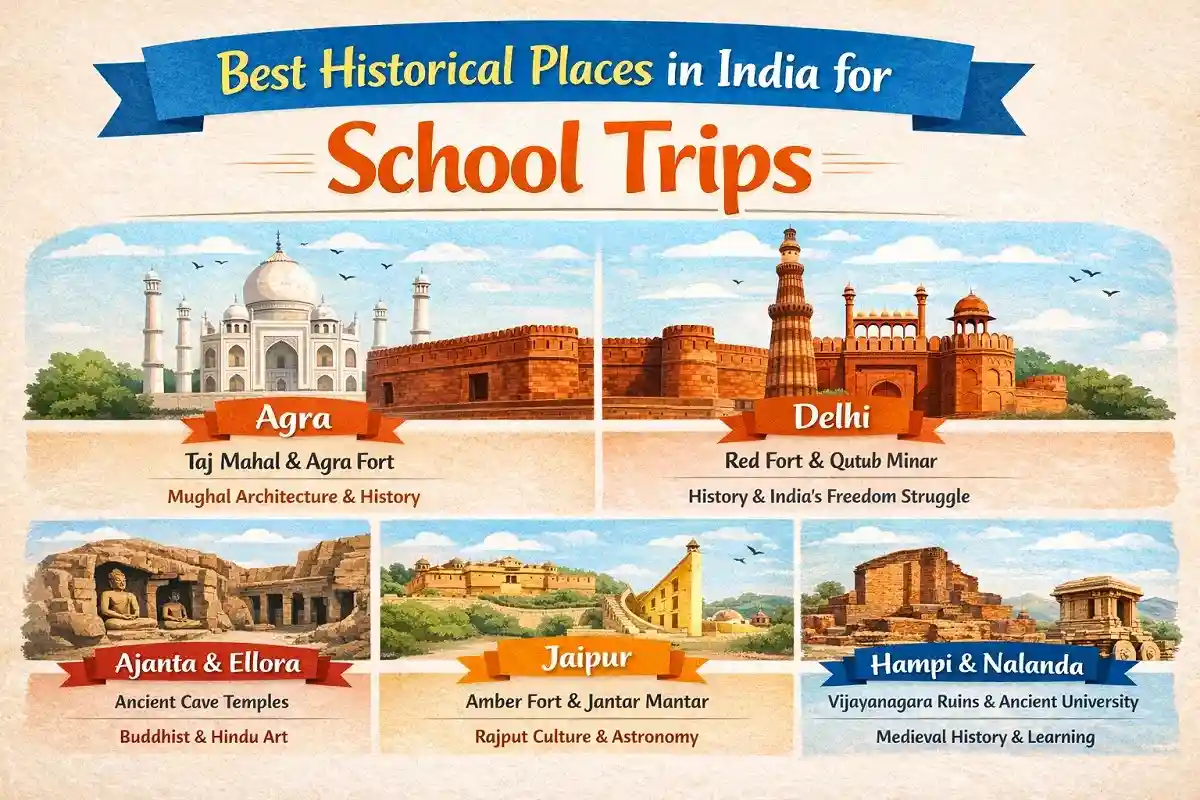
- Heritage and history: Taj Mahal, Hampi, Ajanta and Ellora Caves, Sanchi Stupa, Qutub Minar, Konark Sun Temple, Maratha Military Landscapes — all UNESCO-listed, all textbook-relevant
- Ecology and environment: Western Ghats (biodiversity hotspot), Rann of Kutch (geological uniqueness), Sundarbans (deltaic mangrove ecosystem), Rajasthan (arid land and water management)
- Science and technology: ISRO Space Exhibition (Bengaluru), Nehru Planetarium (Delhi, Mumbai, Bengaluru, Kolkata), TIFR (Mumbai), regional science centres under NCSM (National Council of Science Museums)
- Industrial and vocational: Manufacturing plants, renewable energy farms (Gujarat solar parks), textile clusters, pharmaceutical facilities, food processing units
- Cultural immersion: North-East India (eight states, extraordinary biodiversity and tribal heritage), Ladakh (high-altitude ecosystem and Buddhist culture), Rajasthan and Gujarat craft clusters (living craft traditions)
Many of these destinations are more affordable than parents assume. ASI-protected monuments charge Indian students ₹15–₹40, with free entry for children under 15. Regional science museums and planetariums offer subsidised rates for school groups. NCSM has 25 regional science centres across India — most cities have one within practical reach.
Common Mistakes Schools and Parents Make
- Treating the tour as a reward trip: When the objective is enjoyment rather than learning, neither the preparation nor the post-tour work happens — and neither does the academic benefit.
- Choosing the destination based on popularity rather than curriculum relevance: A beach resort may be enjoyable but contributes little to learning outcomes. A marine biology field station near the same coast is a different matter entirely.
- Skipping pre-tour classroom preparation: Students who arrive at a heritage site with no prior knowledge absorb far less than those who come with specific questions and a working understanding of the context.
- No post-tour consolidation: Without a structured reflection report or class discussion within one week of return, much of the learning fades — consistent with what Ebbinghaus showed about memory without reinforcement.
- Insufficient supervision ratio: One teacher per 30+ students on a field trip is inadequate. The recommended ratio for off-campus educational trips is one teacher per 15–20 students.
- Ignoring student insurance and medical documentation: Every school educational tour should include group travel insurance and documented medical information for every student. This is not optional — and for NEP 2020 compliance, schools are expected to have documented safety protocols.
Pro Tips for Maximising Educational Tour Value
- Time the tour mid-unit — not at the start (students lack context) and not at the very end (the consolidation opportunity is missed). The ideal timing is after 60–70% of the classroom module is complete.
- Use a guided question worksheet, not open-ended observation. Specific, answerable questions — How many arches? What material was used and why? What does the orientation of the structure tell you? — direct student attention effectively.
- For science or ecology tours, request a subject-matter expert guide rather than a general tour guide. Most ISRO centres, national parks, and NCSM science museums can arrange expert-led sessions for school groups with advance booking.
- For overnight trips, use evenings for structured group discussion. End-of-day reflection — ‘What did you observe today that surprised you and why?’ — consolidates learning naturally without feeling like homework.
- Involve students in research before the tour. Let Class 9–12 students prepare a one-page background brief on the destination, identify questions they want answered, and present findings to the group before departure. This deepens engagement before the trip begins.
- Connect the experience back to the classroom for 2–3 weeks after returning. A student who visited a dam will engage differently with a water resources chapter six months later. Make those connections explicit.
Educational Tours vs Classroom Learning: Which Is Better?
The honest answer is neither, in isolation.
Classroom learning provides the curriculum alignment, systematic knowledge-building, and academic foundation that tours build upon. Without it, students visit sites without understanding what they are looking at or why it matters.
Educational tours provide the real-world application, emotional engagement, and experiential context that makes classroom learning meaningful and memorable. Without them, classroom learning risks remaining theoretical — adequate for passing exams, but disconnected from how the world actually works.
The 2025 ScienceDirect study is precise on this point: educational tours are ‘an effective extension and enhancement of classroom teaching and learning’ — not a replacement. The word extension is key. Tours build on what the classroom establishes.
India’s NEP 2020 reflects this understanding. Section 4.6 mandates experiential learning as standard pedagogy. The Bagless Days provision requires schools to formally schedule outdoor and field learning. The policy does not choose between classroom and tour — it requires both.
Frequently Asked Questions
1. What is the difference between educational tours and regular field trips?
Educational tours are specifically designed around curriculum objectives, with pre-tour classroom preparation, structured engagement at the site, and post-tour consolidation work. A regular field trip may simply involve visiting a location without these elements. The difference is intent and execution — not the destination itself.
2. Do educational tours really improve learning outcomes?
Yes, based on multiple verified studies. A 2025 ScienceDirect study confirmed that study tours measurably enhance academic learning, psychological development, and social responsibility. Research by Montgomery and Millenbah found that students learning in real-world settings outperform those who learn only indoors — particularly during the initial learning phase. Active engagement is consistently shown to slow the forgetting curve compared to passive lecture-based instruction.
3. What does the ‘90% retention from doing’ statistic actually mean?
The specific ‘90% vs 10%’ retention figures originate from the Learning Pyramid — a model widely used in education but whose exact percentages have no peer-reviewed scientific source. The original data was never published. The core principle — that active learning leads to significantly better retention than passive instruction — is well-supported by cognitive science research. But the specific percentages should not be cited as verified fact.
4. How does NEP 2020 support educational tours?
NEP 2020 Section 4.6 mandates experiential learning as standard pedagogy across all school stages. The policy also includes a Bagless Days provision requiring schools to schedule outdoor, vocational, and field-based learning days from Class 6 onwards. For schools implementing NEP 2020 reforms, educational tours are not optional — they are part of the formal academic programme.
5. How much does an educational tour cost in India in 2026?
Local day trips cost ₹300–₹800 per student. Regional 2–3 day domestic trips cost ₹2,500–₹8,000. Specialised tours (STEM, ecology) cost ₹5,000–₹20,000. International tours range from ₹60,000 (Asia) to ₹2,50,000+ (Europe). ASI monuments charge ₹15–₹40 for Indian students, with free entry for children under 15. Many science centres offer subsidised school group rates.
6. How many UNESCO World Heritage Sites does India have in 2026?
India has 44 UNESCO World Heritage Sites as of 2026 — 36 Cultural, 7 Natural, and 1 Mixed (Khangchendzonga National Park, Sikkim). India ranks 6th globally. The most recent addition is the Maratha Military Landscapes of India, inscribed in July 2025 at the 47th session of the UNESCO World Heritage Committee.
7. What age group benefits most from educational tours?
Students from Class 5 onwards benefit significantly. The most academically impactful window is Class 7–12, when students have enough classroom foundation to connect what they see to what they know, and when critical thinking skills are actively developing. Younger students (Class 1–4) benefit best from local, shorter trips with simpler learning objectives.
8. How often should schools organise educational tours?
Under NEP 2020, Bagless Days require schools to schedule outdoor and field learning across the academic year from Class 6 onwards. As a general guideline, at minimum one structured educational tour per class per academic year is recommended. Quality matters more than frequency — a single well-prepared tour delivers more than three poorly planned ones.
9. What are the best educational tour destinations in India?
Top curriculum-aligned options include: Delhi–Agra–Jaipur heritage circuit for history; ISRO Bengaluru and Nehru Planetarium for science and technology; Sundarbans or Western Ghats for ecology; Maratha Military Landscape forts for history and architecture; Ranthambhore for wildlife biology; regional NCSM science centres (available in most cities) for applied science.
10. Can classroom learning be made more effective without tours?
Yes. Active learning methods within the classroom — project-based learning, group discussions, simulations, lab experiments, guest speakers, documentary viewing — improve retention compared to passive lectures. These are not substitutes for educational tours but are important complements, especially when budget or logistics limit tour frequency.
11. What should a post-tour assignment include?
Effective post-tour work includes: a structured report connecting specific observations to textbook concepts; a short group presentation to the class; a factual quiz based on site-specific observations; or a guided class discussion. Complete this within one week of returning — while the experience is still vivid and the connection to classroom content is strongest.
12. Is classroom learning becoming obsolete with NEP 2020?
No. Classroom learning remains the foundation of curriculum delivery, structured knowledge-building, and academic assessment. NEP 2020 does not replace the classroom — it requires the classroom to be supplemented with experiential learning. The goal is for both to work together: classroom for structure and theory, educational tours for application and retention.
Conclusion
The question is not whether educational tours work better than classroom learning. The question is how to use both well — and in 2026, India’s policy framework gives schools a clear directive.
NEP 2020 Section 4.6 mandates experiential learning as standard pedagogy. The Bagless Days provision formally schedules outdoor and field-based learning into the academic year. Research from 2025 confirms that study tours deliver measurable academic, social, and developmental gains. India’s 44 UNESCO World Heritage Sites, 25 NCSM science centres, national parks, ISRO exhibitions, and cultural institutions make curriculum-aligned tour destinations accessible across the country.
For teachers and school administrators: start with what is near and affordable. A morning at a local heritage site or science museum, properly prepared and followed up in class, delivers real academic benefit. The constraint is almost never resources — it is planning intent.
For parents: ask your school about Bagless Days implementation and annual educational tour planning. Under NEP 2020, these are not extras — they are part of your child’s formal education. A well-planned two-day trip to a relevant site, tied to the classroom curriculum, can leave a deeper academic impression than weeks of passive notes.
The ideal education in 2026 is not classroom versus tour. NEP 2020 settled that question. It is classroom and tour — each making the other work better.
Must Read: