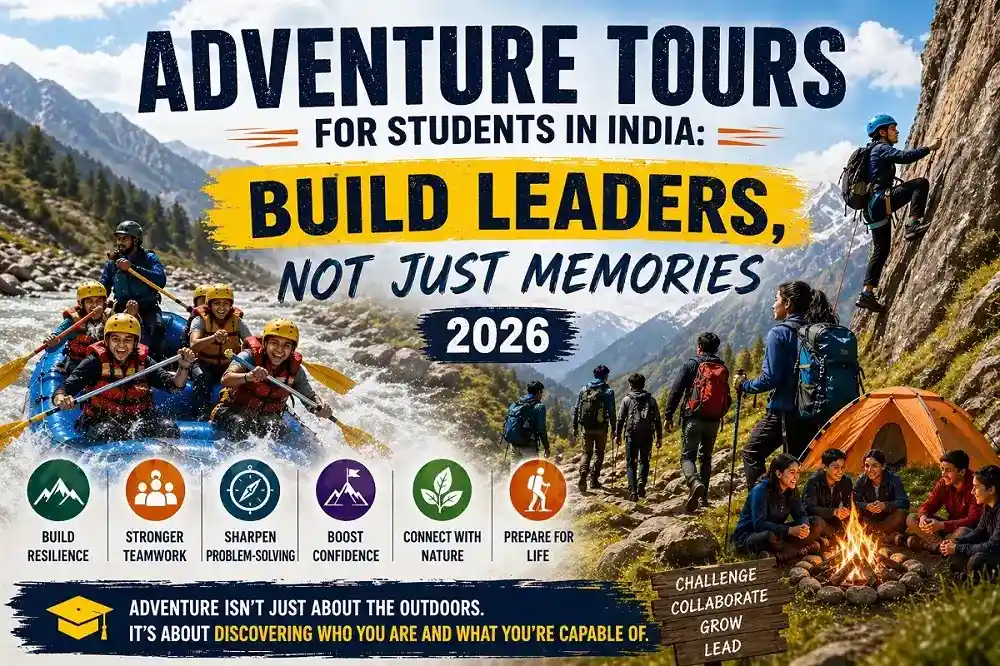
Adventure tours for students are one of the most transformative experiences a school can offer. And yet, they’re also one of the most misunderstood. Many schools think “adventure trip” means a week of fun with no academic value. That couldn’t be further from the truth.
Structured adventure-based education — trekking, river rafting, rock climbing, camping — builds qualities that a classroom simply can’t: resilience, trust, problem-solving under pressure, and leadership. These aren’t soft skills. They’re survival skills for the 21st century.
This guide is for schools, teachers, and parents who want to understand what genuine student adventure tours look like, where to go, what to expect, and how to make every rupee count.
What Is Adventure-Based Education?
Adventure-based education (ABE) is a structured approach where outdoor challenges are used as tools for personal and group development. It’s not just physical activity — every challenge is debriefed, reflected on, and connected to real-world skills.
A student who completes a 3-day Himalayan trek doesn’t just get exercise. They learn to:
- Push through discomfort without quitting
- Depend on teammates when things get hard
- Follow instructions in genuinely high-stakes situations
- Develop self-confidence through completing something difficult
ABE is now recognized by the International Baccalaureate (IB) program as part of the CAS (Creativity, Activity, Service) requirement — which is exactly why more international and premium Indian schools are making adventure tours a curriculum priority, not just a holiday treat.
Top Adventure Activities for Student Groups in India
Not all adventure activities are suitable for all age groups. Here’s a clear breakdown:
| Activity | Minimum Age | Skill Level Required | Best Destination |
|---|---|---|---|
| River Rafting (Grade I–II) | 12 years | Beginner | Rishikesh (Brahmpuri) |
| River Rafting (Grade III–IV) | 14 years | Intermediate | Rishikesh, Coorg |
| Trekking (easy-moderate) | 10 years | Beginner | Uttarkashi, Manali, Munnar |
| Rock Climbing & Rappelling | 12 years | Beginner–Intermediate | Rishikesh, Chopta |
| Camping & Survival Skills | 8 years | All levels | Multiple Himalayan camps |
| Bungee Jumping | 12 years, min 40 kg | Thrill-seeker | Rishikesh, Mohan Chatti |
| High-Altitude Trek | 14 years | Intermediate–Advanced | Kedarkantha, Har Ki Dun |
| Zip-lining / Flying Fox | 10 years | Beginner | Rishikesh, Manali |
| Kayaking | 12 years | Beginner | Rishikesh, Coorg |
| Paragliding | 14 years | Beginner (tandem) | Bir Billing, Manali |
The activity choice should match the students’ age, fitness level, and the school’s comfort with risk. A professional operator will always assess group fitness before finalizing the itinerary.
Best Destinations for Student Adventure Tours in India
Rishikesh, Uttarakhand
Rishikesh is known as a hub for spirituality and adventure — offering activities like white-water rafting, cliff jumping, and camping by the Ganges. For student groups, it’s arguably the most complete adventure destination in India. In one trip, students can raft the rapids, trek to a viewpoint, attend the Ganga Aarti, and camp under the stars. The logistics are well-developed, making it easier for operators to run safe, structured programs.
Best for: Classes 7–12, adventure + spiritual + cultural combination
Uttarkashi, Uttarakhand
Less touristy than Rishikesh but equally dramatic. Uttarkashi is home to the Nehru Institute of Mountaineering (NIM) — one of India’s premier adventure training institutions. Camping and trekking programs here are serious, well-structured, and deeply rewarding.
Best for: High school and senior students seeking more rigorous programs
Manali, Himachal Pradesh
Snow peaks, river crossings, mountain biking, and some of India’s best high-altitude treks — Manali is a classic for student adventure trips. The Solang Valley and Rohtang area offer multiple activities in a concentrated zone, which is efficient for school group logistics.
Best for: Summer trips (May–June), Classes 8–12
Coorg, Karnataka
For schools in South India, Coorg is one of the best adventure destinations. River activities on the Barapole and Cauvery rivers, trekking through coffee estates, and zip-lining across valleys — all in a lush, green landscape.
Best for: Schools from Bangalore, Chennai, Hyderabad; Classes 6–12
Spiti Valley, Himachal Pradesh
This is the high-altitude frontier — remote, raw, and deeply educational. Spiti is best for older students who can handle altitude and limited facilities. The cultural immersion alongside the adventure makes it a genuinely unique experience.
Best for: Classes 11–12 and college groups, experienced trekkers only
What Happens at a Student Adventure Camp: A Day-by-Day Glimpse
Many parents and teachers have no idea what actually happens during an adventure camp. Here’s a realistic picture of a 5-day adventure program at a Himalayan camp:
Day 1: Arrival, camp orientation, ice-breaker activities, basic safety briefing. Evening bonfire and group discussion.
Day 2: Rock climbing and rappelling session (morning). Team-building exercises (afternoon). River walk in the evening.
Day 3: River rafting — full-day expedition. Pre-briefing on safety, river reading, paddle commands. Post-activity debrief at camp.
Day 4: Trek to a nearby viewpoint or waterfall. Navigation exercise, nature journaling. Campfire cooking session in the evening.
Day 5: Camp cleanup (responsibility activity), closing ceremony, certificate distribution. Departure.
Every day is designed with both a physical challenge and a reflective component. Students don’t just do things — they think about what they did and why.
The Role of Trained Outdoor Educators
This is the piece that separates a good adventure program from a dangerous one. The person leading your students isn’t just a guide — they’re an outdoor educator.
Reputable operators hire instructors with certifications from bodies like:
- Nehru Institute of Mountaineering (NIM), Uttarkashi
- Himalayan Mountaineering Institute (HMI), Darjeeling
- Adventure Tour Operators Association of India (ATOAI)
- Wilderness First Responder (WFR) certification for medical emergencies
Ask your operator: “What are the qualifications of the staff who will be with our students?” If they can’t answer clearly, that’s a red flag.
Safety Standards for Student Adventure Tours: What Schools Must Demand
Safety in adventure tourism for students cannot be compromised. Here are the non-negotiables:
Equipment:
- ISI/CE-certified harnesses, helmets, and life jackets — no exceptions
- Equipment inspected before every use
- Backup safety lines on all high-altitude activities
Staff:
- Minimum 1 trained instructor per 8–10 students for high-risk activities
- At least 1 female staff member for mixed-gender groups
- 24/7 emergency contact with operator’s senior management
Medical:
- First-aid trained staff on every program
- Nearest hospital/clinic locations identified before arrival
- Medical consent forms collected from every student
- Allergy and health condition documentation
Communication:
- Satellite phone or radio communication in remote areas
- Emergency evacuation plan documented and rehearsed
Accreditation:
- Operator should be registered with the Ministry of Tourism
- Adventure programs should follow ATOAI guidelines
How Adventure Tours Connect to the School Curriculum
This is the question principals and boards care about most: what’s the academic value?
Here’s how smart schools tie adventure programs to the curriculum:
Science: Understanding river hydraulics, mountain geology, weather patterns, altitude and its effects on the human body
Geography: Map reading, topography, climate zones, local ecosystems
Biology: Forest ecology, biodiversity, animal behavior (especially on wildlife safari components)
Physical Education: Endurance, strength, teamwork, health and fitness
Life Skills / Value Education: Resilience, leadership, empathy, environmental responsibility
IB CAS / CBSE Activity Credits: Most adventure programs are directly usable as Activity credits under CAS and similar frameworks
The key is the structured debrief after each activity — this is where the teacher or instructor connects the experience to classroom concepts.
Cost Guide for Student Adventure Tours
| Program Type | Duration | Approx Cost Per Student |
|---|---|---|
| Weekend adventure camp (Rishikesh) | 2 nights / 3 days | ₹5,000–₹9,000 |
| Himalayan trekking program | 5 nights / 6 days | ₹12,000–₹22,000 |
| Multi-activity camp (Manali/Uttarkashi) | 5 nights / 6 days | ₹14,000–₹25,000 |
| High-altitude trek (Kedarkantha, Har Ki Dun) | 6 nights / 7 days | ₹18,000–₹30,000 |
| International adventure tour (Nepal, Bhutan) | 7–10 days | ₹50,000–₹90,000+ |
Prices vary based on group size, accommodation type, and the number of activities included. Always ask for an itemized breakdown — what’s included and what’s extra.
Mistakes Schools Make When Planning Adventure Tours
- Choosing the cheapest operator: Penny-wise, safety-foolish. Adventure activities have inherent risks. You need experienced, certified operators.
- Not checking student health forms: A student with asthma or a heart condition needs different activity modifications.
- Too many activities in too little time: An overpacked itinerary means rushed briefings, tired students, and higher accident risk.
- Skipping the post-trip debrief: The learning value drops dramatically without structured reflection.
- Going without female staff on co-ed trips: Non-negotiable for overnight programs.
FAQs: Adventure Tours for Students
1. Are adventure tours safe for school students?
Yes, when organized by certified operators with trained staff, proper equipment, and documented safety protocols. The risk is never zero, but professional operators mitigate it significantly through training and preparation.
2. What should students pack for an adventure camp?
Quick-dry clothing (2–3 sets), sturdy closed-toe shoes or trekking shoes, a light rain jacket, personal medications, sunscreen, a reusable water bottle, a headlamp, and a personal first-aid kit. The operator should provide a detailed packing list.
3. Do students need to know how to swim for river rafting?
No. Life jackets are mandatory, and instructors are trained in water rescue. That said, basic swimming ability is a plus, and operators will brief students on what to do if they fall into the water.
4. Can physically unfit students participate?
Most adventure programs offer a range of activities at different intensity levels. Speak with the operator about specific health conditions. Students with significant limitations can often participate in modified activities.
5. How do adventure tours help introverted or shy students? They work exceptionally well. Adventure activities create situations where everyone needs everyone else — and quiet students often discover leadership qualities they didn’t know they had. The unstructured nature of camping also allows shy students to connect more naturally than in a school setting.
6. Is there phone access during adventure camps?
Most Himalayan camps have limited or no phone connectivity. This is actually considered a feature by educators — a digital detox that forces students to engage with their surroundings and each other.
7. What if a student wants to skip an activity?
Reputable programs never force participation. Instructors are trained to encourage, but a student’s right to opt out is always respected. Alternatives are arranged.
8. How do we get school board approval for adventure trips?
Present a detailed proposal including: operator credentials, itinerary, safety protocols, emergency procedures, cost breakdown, and parent consent process. Schools with prior adventure trip experience can provide reference letters.
9. What is the ideal group size for a student adventure camp?
Between 30 and 60 students is typically the sweet spot — large enough for economies of scale, manageable enough for safety and quality instruction. Very large groups (100+) require multiple instructors and more complex logistics.
10. How soon should we book for a summer adventure camp?
Summer camps (May–June) are in high demand. Book at least 4–5 months in advance to secure availability, especially for popular Himalayan destinations. October–November programs can be booked 2–3 months ahead.
Adventure tours for students are not a luxury — they’re an investment in the kind of human beings you’re helping them become. Choose your operator carefully, plan with intention, and watch your students surprise themselves.