Best Historical Places in India for School Educational Tours
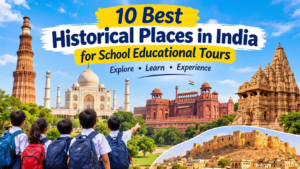
Historical Places in India for Educational Tours offer students an excellent opportunity to explore the country’s rich history, cultural heritage, ancient architecture and significant historical events beyond their textbooks. From the magnificent Mughal monuments of Agra to the royal forts of Rajasthan and the ancient caves of Maharashtra, India has countless destinations where students can experience history through real-life exploration. Visiting these places helps students understand the stories of ancient civilisations, powerful dynasties, freedom fighters and cultural traditions that have shaped India’s identity.
School educational tours are an effective way to combine academic learning with travel experiences. Instead of simply reading about historical events in classrooms, students can visit important monuments, museums, forts and archaeological sites to understand their historical significance. These journeys encourage curiosity, improve historical knowledge and create memorable learning experiences.
For schools planning meaningful excursions, Historical Places in India for Educational Tours provide a wide range of opportunities for experiential learning. Whether it is exploring Mughal architecture, understanding India’s freedom movement or discovering ancient Indian civilisation, every destination offers something valuable for young learners.
Let’s explore some of the best historical destinations that schools can include in their educational tour itineraries.
Why Choose Historical Places in India for Educational Tours?
History becomes more interesting when students can experience it themselves. Visiting historical destinations helps students connect classroom knowledge with real-world surroundings. They can observe ancient structures, understand architectural styles, explore museums and learn about the people who shaped Indian history.
Organising Historical Places in India for Educational Tours also provides several educational benefits:
- Practical Learning: Students gain first-hand knowledge of historical events, monuments and ancient civilisations.
- Cultural Awareness: They understand India’s diverse traditions, religions, art forms and architectural heritage.
- Critical Thinking: Exploring historical sites encourages students to ask questions and analyse the significance of historical events.
- Teamwork: Travelling in groups develops cooperation, communication and social skills.
- Experiential Education: Students learn through observation, exploration and interaction rather than depending entirely on textbooks.
Educational trips also help students develop independence, confidence and a deeper appreciation of India’s cultural identity.
10 Best Historical Places in India for School Trips
India has numerous destinations that offer excellent opportunities for history-based learning. Here are ten recommended destinations that schools should consider when planning historical educational tours in India.
1. Agra, Uttar Pradesh – Explore the Mughal Heritage
Agra is one of India’s most important historical destinations and an excellent choice for school educational trips. The city is home to the world-famous Taj Mahal, a UNESCO World Heritage Site and a remarkable example of Mughal architecture.
Students can also visit Agra Fort, which played an important role during the Mughal Empire, and Fatehpur Sikri, the historic city established by Emperor Akbar.
Educational highlights:
- Understand Mughal history and the contributions of important emperors.
- Explore Indo-Islamic architecture and artistic craftsmanship.
- Learn about UNESCO World Heritage conservation.
- Discover the historical significance of Fatehpur Sikri.
An educational visit to Agra helps students understand India’s medieval history, architecture and cultural development.
2. Jaipur, Rajasthan – Discover the Royal History of Rajasthan
Jaipur, popularly known as the Pink City, is famous for its magnificent forts, royal palaces and traditional architecture. It offers an excellent opportunity for students to learn about Rajput history and Rajasthan’s royal heritage.
Important attractions include Amber Fort, City Palace, Hawa Mahal and Jantar Mantar. Each destination provides insights into the lifestyle, administration, architecture and scientific achievements of earlier generations.
Educational highlights:
- Learn about Rajput rulers and their historical contributions.
- Understand traditional fort architecture and defensive systems.
- Explore Jantar Mantar and its astronomical instruments.
- Discover the cultural traditions of Rajasthan.
Jaipur is particularly suitable for combining history, science, art and cultural learning in one educational tour.
3. Delhi – Explore India’s Historical Capital
Delhi is among the most fascinating Historical Places in India for Educational Tours because its history stretches across several centuries. The city has witnessed the rise and fall of numerous dynasties and empires.
Students can explore the Red Fort, Qutub Minar, Humayun’s Tomb and Purana Qila to understand different periods of Indian history. India Gate also provides an opportunity to discuss the contributions and sacrifices of Indian soldiers.
The National Museum offers additional learning opportunities through its collections of sculptures, coins, paintings, manuscripts and archaeological objects.
Educational highlights:
- Understand the Delhi Sultanate and Mughal period.
- Learn about India’s freedom struggle and independence.
- Explore different architectural styles.
- Discover the political and historical evolution of Delhi.
A Delhi educational tour can be particularly valuable for students studying Indian history, civics and social science.
4. Varanasi, Uttar Pradesh – Experience India’s Ancient Cultural Heritage
Varanasi is one of the world’s oldest continuously inhabited cities and an important centre of Indian cultural and spiritual heritage. The city provides students with an opportunity to understand ancient traditions, religious practices, literature and cultural evolution.
Students can explore the historic ghats, visit Sarnath and learn about the city’s connection with Buddhism through the teachings of Gautama Buddha.
Educational highlights:
- Understand India’s ancient cultural traditions.
- Explore the historical significance of Sarnath.
- Learn about Buddhism and its development.
- Observe traditional crafts, music and cultural practices.
Varanasi is an excellent destination for schools interested in combining history, culture and heritage education.
5. Amritsar, Punjab – Learn About India’s Freedom Struggle
Amritsar holds an important place in Indian history, particularly because of its connection with the freedom movement. The city provides students with opportunities to understand India’s struggle for independence and the sacrifices made by freedom fighters.
The Golden Temple, Jallianwala Bagh and Partition Museum are among the most significant attractions for educational visits.
Educational highlights:
- Learn about the Jallianwala Bagh massacre.
- Understand important events of India’s independence movement.
- Explore the history and cultural significance of the Golden Temple.
- Discover the human stories behind the Partition of India.
A school visit to Amritsar helps students develop a deeper understanding of India’s national history and cultural diversity.
6. Hampi, Karnataka – Discover the Vijayanagara Empire
Hampi is a UNESCO World Heritage Site and one of India’s most remarkable archaeological destinations. Once the capital of the Vijayanagara Empire, it contains impressive temples, royal structures, market streets and stone monuments.
The Virupaksha Temple, Vittala Temple and Stone Chariot are among its most famous attractions.
Educational highlights:
- Understand the rise and decline of the Vijayanagara Empire.
- Explore ancient temple architecture.
- Learn about historical trade and urban planning.
- Discover the importance of archaeological conservation.
Hampi is particularly suitable for students interested in ancient Indian history, archaeology and architecture.
7. Khajuraho, Madhya Pradesh – Explore Ancient Indian Art and Architecture
Khajuraho is famous for its beautifully carved temples and remarkable examples of medieval Indian architecture. The temples were primarily constructed during the Chandela dynasty and represent the artistic excellence of that period.
The Western Group of Temples is particularly popular among visitors and educational groups.
Educational highlights:
- Study ancient Indian sculpture and temple architecture.
- Understand the contributions of the Chandela dynasty.
- Explore historical craftsmanship and stone carvings.
- Learn about heritage preservation and UNESCO recognition.
Khajuraho offers a valuable learning experience for students interested in history, art and architecture.
8. Ajanta and Ellora Caves, Maharashtra – Understand Ancient Indian Civilisation
The Ajanta and Ellora Caves are among India’s most important historical and archaeological attractions. These cave complexes demonstrate the artistic, religious and architectural achievements of ancient India.
Ajanta is particularly famous for its Buddhist paintings and sculptures, while Ellora features Buddhist, Hindu and Jain monuments.
Educational highlights:
- Understand the development of ancient Indian religions.
- Explore rock-cut architecture and sculpture.
- Learn about ancient painting techniques.
- Discover the importance of archaeological preservation.
These caves are excellent destinations for students studying ancient history, art, culture and archaeology.
9. Mysore, Karnataka – Experience the Heritage of Royal India
Mysore is known for its royal heritage, magnificent palaces and cultural traditions. The Mysore Palace is one of India’s most recognised historical landmarks and offers students an opportunity to understand the history of the Wadiyar dynasty.
Other attractions, including Srirangapatna, provide insights into the history of Tipu Sultan and the Anglo-Mysore Wars.
Educational highlights:
- Learn about the Wadiyar dynasty.
- Understand the history of Tipu Sultan.
- Explore royal architecture and traditional art.
- Discover the historical importance of Srirangapatna.
Mysore is a suitable destination for schools interested in royal history, architecture and cultural heritage.
10. Jaisalmer, Rajasthan – Discover the Living Heritage of the Desert
Jaisalmer, popularly called the Golden City, is famous for its sandstone architecture, historic havelis and impressive desert fort. Jaisalmer Fort is particularly interesting because it remains a living fort, with residential areas, shops and temples within its walls.
Students can also explore Patwon Ki Haveli and Nathmal Ki Haveli to understand traditional Rajasthani craftsmanship.
Educational highlights:
- Understand the history of desert trade routes.
- Explore traditional sandstone architecture.
- Learn about Rajput culture and heritage.
- Discover the lifestyle of communities in desert regions.
Jaisalmer provides an opportunity to combine historical exploration with geographical and cultural learning.
How Historical Educational Tours Help Students Learn Beyond Classrooms
Visiting historical monuments gives students a different perspective on subjects they study in school. A chapter about the Mughal Empire becomes more interesting when students see the Red Fort or Agra Fort in person.
Similarly, lessons about ancient Indian civilisation become more meaningful when students explore Ajanta and Ellora or the archaeological remains of Hampi.
Historical Places in India for Educational Tours support learning across several academic subjects:
- History: Understanding dynasties, empires, rulers and important historical events.
- Geography: Learning about the geographical location and strategic importance of historical cities.
- Art and Architecture: Observing sculptures, paintings, monuments and construction techniques.
- Civics: Understanding India’s national identity, independence movement and cultural diversity.
- Environmental Studies: Learning about heritage conservation and responsible tourism.
Teachers can make these visits more interactive through heritage worksheets, group assignments, photography activities and guided discussions.
Planning Historical Places in India for School Trips
Planning a successful educational tour requires more than selecting a destination. Schools should ensure that the itinerary offers a balance of learning, comfort, safety and recreation.
Here are some important points to consider:
1. Select Age-Appropriate Destinations: Choose destinations according to students’ age groups, academic subjects and learning objectives.
2. Prepare Educational Itineraries: Include important monuments, museums, heritage sites and interactive learning experiences.
3. Arrange Experienced Tour Coordinators: Professional tour coordinators can help manage transportation, accommodation, meals and group activities.
4. Focus on Student Safety: Ensure proper supervision, reliable transport, suitable accommodation and emergency arrangements.
5. Include Guided Heritage Experiences: Knowledgeable local guides can explain historical facts, architectural features and cultural significance.
When organised properly, Historical Places in India for Educational Tours become meaningful learning experiences that students remember long after returning to school.
Why Choose Shikhar Educational Tours for Historical School Trips?
Choosing the right educational travel partner is essential for organising a successful school trip. Shikhar Educational Tours focuses on creating educational travel experiences that combine exploration, knowledge and personal development.
With experience in organising educational tours, Shikhar helps schools plan journeys that introduce students to India’s historical, cultural, geographical and natural heritage.
Whether your school is planning a heritage tour of Delhi and Agra, a royal Rajasthan exploration or a cultural journey through Varanasi and Amritsar, educational travel programmes can be designed around the students’ academic interests and requirements.
Why consider Shikhar Educational Tours?
- Educational itineraries designed for school groups.
- Destinations selected for their learning value.
- Organised transportation and accommodation arrangements.
- Group coordination and student-focused travel planning.
- Opportunities to learn through real-world experiences.
The objective is to make every educational journey informative, enjoyable and memorable.
Explore educational travel opportunities at https://shikhareducationaltours.com/.
Follow Us & Learn With Us
Get travel inspiration, exciting destinations, tour updates & special offers.
Conclusion
India’s historical heritage offers endless opportunities for students to learn, explore and develop a deeper understanding of the country’s past. From the Mughal monuments of Agra and Delhi to the ancient caves of Maharashtra and the royal heritage of Rajasthan, every destination provides a unique educational experience.
Planning Historical Places in India for Educational Tours allows schools to introduce students to history through practical experiences, cultural exploration and meaningful interactions. These journeys help students develop curiosity, respect for heritage and a stronger connection with India’s rich cultural identity.
With carefully planned itineraries and professional travel support from Shikhar Educational Tours, schools can transform ordinary school trips into memorable educational journeys.
Frequently Asked Questions (FAQs)
1. Which are the best historical places in India for school educational tours?
Agra, Delhi, Jaipur, Varanasi, Amritsar, Hampi, Khajuraho and Ajanta-Ellora are excellent destinations for historical school educational tours.
2. Why are historical educational tours important for students?
They provide practical learning experiences, improve historical understanding and help students explore India’s culture, architecture and heritage.
3. Which historical places are suitable for a short school trip?
Delhi, Agra and Jaipur are suitable for short educational trips, depending on the school’s starting location and available travel time.
4. What can students learn during historical school trips?
Students can learn about ancient civilisations, dynasties, architecture, freedom movements, cultural traditions and heritage conservation.
5. Does Shikhar Educational Tours organise historical trips for schools?
Yes. Shikhar Educational Tours offers educational travel programmes for schools and institutions, with itineraries that can be planned around academic interests and group requirements.