Ask a student to read about the Mughal Empire for 45 minutes, and half the class will drift off by page three. Take those same students to the Agra Fort, let them walk through the red sandstone corridors where Akbar once held court, and they’ll remember it for twenty years.
That’s the core argument for heritage and cultural educational tours for students — history learned in context sticks in a way that textbook history simply doesn’t. India, with its 5,000 years of unbroken civilization, is arguably the greatest classroom on earth for any student of history, culture, art, or social studies.
This guide covers why heritage tours matter, where to go, how to plan, and what makes the difference between a trip students forget and one they carry with them into adulthood.
Why Heritage Tours Are Essential, Not Optional
India’s school curriculum covers a lot of history. The Harappan civilization, the Maurya and Gupta empires, the Delhi Sultanate, the Mughals, the Marathas, the colonial period, Independence — it’s a staggering sweep of time. Most of it is taught through textbooks, maps, and the occasional documentary.
Heritage field trips change the relationship students have with this material.
When a student stands at the top of Chittorgarh Fort and looks out over the same plains where Rana Pratap’s forces once massed, history becomes something felt, not just known. When they trace their fingers along the intricate stone carvings at Khajuraho, art history stops being a chapter title and becomes a real conversation about human expression and cultural context.
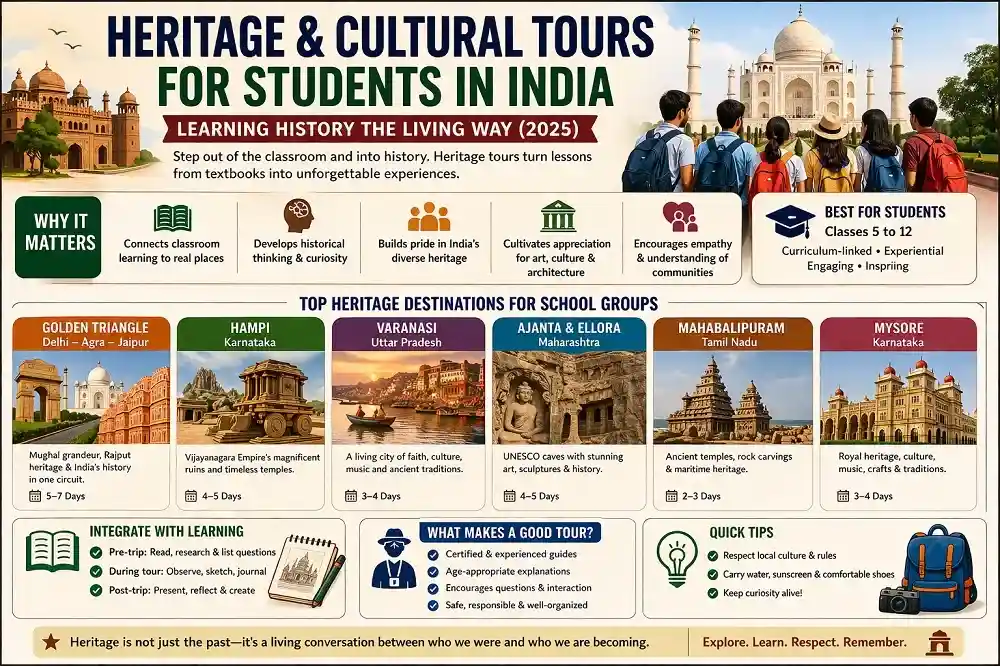
Key educational benefits of heritage tours:
- Connect national curriculum content to real physical places
- Develop historical thinking — primary sources, evidence, interpretation
- Build pride in and curiosity about India’s multicultural heritage
- Cultivate aesthetic sensibility through architecture, music, and art
- Develop empathy by understanding how different communities lived, believed, and created
India’s Greatest Heritage Destinations for School Groups
The Golden Triangle: Delhi – Agra – Jaipur
This is India’s most-traveled heritage circuit for students — and for good reason. Three cities, three distinct eras, three very different architectural vocabularies.
Delhi: A city of historical layers. From the Qutb Minar (12th century) to Humayun’s Tomb (16th century) to India Gate (20th century), Delhi is a compressed timeline of Indian history. Add the National Museum and the National Rail Museum for curriculum-linked depth.
Agra: The Taj Mahal needs no introduction — but students who come with context (understanding of Mughal architecture, Shah Jahan’s motivations, the 20,000 workers over 22 years) experience it completely differently from those who arrive without preparation. The Agra Fort and Fatehpur Sikri round out a comprehensive Mughal learning experience.
Jaipur: The Pink City introduces students to Rajput architecture and culture. Amber Fort, City Palace, Hawa Mahal, Jantar Mantar (an 18th-century astronomical observatory that still functions accurately) — Jaipur is layered with stories.
Best for: All classes from 5 onwards, history and social science integration Ideal duration: 5–7 days Best season: October–March
Hampi, Karnataka
A UNESCO World Heritage Site and once the capital of the Vijayanagara Empire — one of the largest and most powerful Hindu kingdoms in Indian history. Hampi’s ruins spread across a boulder-strewn landscape that is simultaneously eerie and magnificent.
What students experience here:
- The scale of a medieval South Indian capital city
- How temples served as economic and cultural centers, not just religious ones
- The Virupaksha Temple — still an active place of worship after 700 years
- The Vittala Temple complex with its famous Stone Chariot
Best for: Classes 7–12, South Indian history focus, art and architecture appreciation Best season: October–February
Varanasi, Uttar Pradesh
Varanasi is arguably the most intense cultural learning experience in India. One of the world’s oldest continuously inhabited cities, it functions as a living textbook of Hindu civilization — philosophy, ritual, music, arts, and the relationship between life, death, and the sacred river.
The evening Ganga Aarti at Dashashwamedh Ghat, the morning boat rides, the narrow galis of the old city, the weavers of Banaras silk — everything here has centuries of meaning behind it.
Note for school groups: Varanasi is an extraordinary experience but requires careful preparation and a sensitive, knowledgeable guide. The burning ghats are present and visible; teachers should have contextual discussions with students before and after.
Best for: Classes 9–12, philosophy, culture, and religion curriculum
Ajanta and Ellora Caves, Maharashtra
These UNESCO-listed cave complexes are among humanity’s greatest artistic achievements. Ajanta’s painted caves (2nd century BCE to 6th century CE) contain Buddhist murals of extraordinary sophistication. Ellora’s caves — spanning Buddhist, Hindu, and Jain traditions — represent 600 years of artistic continuity.
The Kailasa Temple at Ellora (Cave 16) is particularly mind-bending: a monolithic temple carved entirely downward out of a single rock face. Students who understand the engineering challenge involved are astonished that it was created by hand, in the 8th century.
Best for: Art history, ancient Indian civilization, Classes 8–12
Mahabalipuram, Tamil Nadu
A seashore UNESCO Heritage Site just 60 km from Chennai, Mahabalipuram was a 7th–8th century Pallava dynasty port and artistic centre. The Shore Temple (standing in the sea), the Arjuna’s Penance bas-relief (the world’s largest open-air rock carving), and the Five Rathas give students a concentrated dose of South Indian sculpture and architecture.
Best for: South India history focus, art, ancient maritime trade context
Mysore, Karnataka
The Mysore Palace is one of India’s most opulent royal residences, still used for the famous Mysore Dasara festival. The city also offers the Chamundeshwari Temple, Brindavan Gardens, and a strong tradition of Carnatic music, silk weaving, and handicrafts. Cultural diversity and artistic tradition come alive in Mysore in a very accessible way.
Best for: Culture, arts, and crafts focus; classes 5 and above
Integrating Heritage Tours with the School Curriculum
A heritage tour is most educationally valuable when it connects directly with what students are studying in class. Here’s how to make that happen:
| Subject | How Heritage Tours Connect |
|---|---|
| History | Direct encounter with primary sources — architecture, inscriptions, artifacts |
| Geography | Understanding how river valleys, trade routes, and terrain shaped civilizations |
| Art | Seeing original artworks, architectural styles, and artistic traditions in context |
| Social Studies | Caste, religion, trade, governance — all visible in heritage sites |
| Literature | Understanding the cultural context of ancient texts, epics, and stories |
| Mathematics | Mughal garden geometry, astronomical instrument accuracy, architectural proportions |
Pre-trip activity: Ask students to read about the destination and submit 3 questions they want answered during the visit. This activates curiosity and gives teachers insight into student thinking.
During the tour: Assign a “Heritage Journal” — students sketch buildings, record impressions, and answer their own pre-submitted questions.
Post-trip activity: A group presentation, documentary, or creative writing assignment that processes what they experienced.
What to Expect on a Heritage Tour: A Sample Itinerary
5-Day Rajasthan Heritage Tour (Jaipur–Jodhpur–Udaipur)
| Day | Activities |
|---|---|
| Day 1 | Arrival Jaipur. Amber Fort (morning), City Palace & Jantar Mantar (afternoon) |
| Day 2 | Hawa Mahal, local textile market, Jaipur bazaar cultural walk |
| Day 3 | Travel to Jodhpur. Mehrangarh Fort (afternoon), Blue City walk |
| Day 4 | Travel to Udaipur. City Palace, Lake Pichola boat ride, local craftspeople interaction |
| Day 5 | Fateh Sagar Lake, Sajjangarh Monsoon Palace. Return journey |
Each day has a structured learning component — not just sightseeing but guided interpretation with meaningful questions and observations.
Choosing a Heritage Tour Guide: Why Expertise Matters
A heritage site visit is only as good as the knowledge that accompanies it. An untrained guide can make the Taj Mahal boring. An expert guide can make a 15th-century ruined fort feel alive and urgent.
When evaluating tour operators, ask specifically about guide qualifications:
- Are guides certified by the Ministry of Tourism as Approved Tourist Guides?
- Do they have subject-specific knowledge (architecture, history, religion)?
- Can they calibrate their presentation to the age and knowledge level of students?
- Do they encourage student questions rather than just delivering a monologue?
The best guides are storytellers who use architecture as a narrative tool. Find those people, and your heritage tour will be remembered for decades.
Cost Guide for Heritage Educational Tours
| Tour | Duration | Approx Cost Per Student |
|---|---|---|
| Golden Triangle (Delhi-Agra-Jaipur) | 5–6 days | ₹8,000–₹16,000 |
| Rajasthan Heritage Circuit | 7–8 days | ₹12,000–₹22,000 |
| South India Heritage (Chennai-Mahabalipuram-Mysore) | 6–7 days | ₹12,000–₹20,000 |
| Ajanta-Ellora + Aurangabad | 4–5 days | ₹9,000–₹15,000 |
| Varanasi-Lucknow Cultural Tour | 4–5 days | ₹7,000–₹13,000 |
| Hampi-Badami Heritage Tour | 5–6 days | ₹10,000–₹18,000 |
FAQs
Q-1: At what age can students start benefiting from heritage tours?
Ans: From Class 4–5, students have enough historical context to appreciate heritage sites in a basic way. Deeper understanding comes with Class 7 and above, when curriculum history becomes more detailed and students can engage with complex questions about civilizations.
Q-2: Is the Golden Triangle (Delhi-Agra-Jaipur) overdone for school trips?
Ans: It’s popular for good reason — the density of world-class heritage within a compact geographic area is unmatched. Rather than avoiding it, schools should focus on making the experience deeper through expert guides, thematic focus, and structured curriculum connection.
Q-3: How do we handle religious and cultural sensitivity at heritage sites?
Ans: Brief students before arrival — dress requirements, photography rules, behavior near active places of worship. A good tour operator will provide this guidance proactively. Treat every site with the respect you’d want shown to your own tradition.
Q-4: Can heritage tours work for students who “don’t like history”?
Ans: Often, these students are the ones who benefit most. Many students who find textbook history boring come alive when they see it in three dimensions. The physical reality of a place — its scale, craftsmanship, and atmosphere — does something a textbook page simply cannot.
Q-5: What is the best way to prepare students for a heritage tour?
Ans: Show a 10-minute documentary about the destination, assign brief background reading, and ask students to submit questions in advance. Students who arrive curious get five times the value from the experience.
Q-6: Are there heritage tours suitable for students learning about India’s medieval Islamic history
Ans: Absolutely. Fatehpur Sikri, Humayun’s Tomb, Qutb Minar, Bijapur’s Gol Gumbaz, and the ruins of Mandu are all extraordinary sites that tell the story of Islamic architectural and cultural contribution to India’s heritage.
Q-7: How do heritage tours address India’s colonial history?
Ans: Calcutta (Kolkata) is the best destination for this — Victoria Memorial, Writer’s Building, Indian Museum, and the architecture of the colonial quarter tell a complex story of empire and resistance. Delhi’s Lutyens’ zone and Amritsar’s Jallianwala Bagh are also powerful sites for understanding this period.
Q-8: Should schools use the same heritage destination for multiple years?
Ans: It’s better to rotate. Returning to the same city doesn’t deepen learning as much as exposing students to new regions, different dynastic traditions, and diverse artistic vocabularies.
Q-9: Are there winter heritage tours that work despite cold weather?
Ans: Delhi-Agra-Jaipur in December–January is actually peak season — crisp, clear days, no haze on the Taj Mahal, and cool enough to walk comfortably. Most heritage sites in the plains are perfectly accessible in winter.
Q-10: How do we document the heritage tour experience for academic purposes?
Ans: Photography journals, sketch diaries, student-produced short films, blog posts, or formal reports. Many schools use the tour as the basis for a Social Studies or History project that carries academic weight. This turns the experience into an assessed learning outcome — and gives the trip formal educational validity.
India’s heritage is not the past — it’s a living conversation between who we were and who we are becoming. Educational heritage tours give students a chance to be part of that conversation, not just observe it from a distance.
Suggested to Read: