
Stargazing Camp
A unique one-day experiential learning program conducted right at the school campus, introducing students to the fascinating world of astronomy.
Program Overview
The Stargazing Camp Educational Tour is designed to spark a lifelong interest in space science through interactive activities, practical experiments, and guided night sky observation. It transforms theoretical physics and astronomy concepts into memorable real-life experiences.
From building pressure rockets to peering through professional telescopes at distant galaxies, students get hands-on exposure to celestial mechanics, engineering, and observational astronomy.
- Venue: School Playground / Open Campus Area
- Curriculum Focus: Physics, Engineering, Astronomy, and Celestial Navigation
- Notice: Telescope viewing is highly dependent on local weather and cloud cover
Registration & Introduction to Astronomy
The program begins with participant registration and a comprehensive briefing, where students are introduced to the objectives of the camp, basic astronomical concepts, and the exciting activities planned throughout the day.
Hands-On Aerospace Engineering
The learning experience starts with a hands-on Water Air Pressure Rocket Making activity, allowing students to understand the principles of air pressure, force, and Newton's laws of motion through an engaging practical experiment. This is followed by an interactive session on Space Lander design, where students explore the concept of air resistance and learn how spacecraft safely land on planetary surfaces through simple engineering models and demonstrations.
Mapping the Cosmos
After lunch, participants are introduced to the Planisphere, a practical star chart that serves as a year-round guide to the night sky. Students learn how to read and use the Planisphere to identify constellations, stars, and celestial objects according to the date and time. The session is complemented by an informative astronomy presentation covering topics such as the solar system, stars, galaxies, nebulae, planets, and the basics of celestial navigation.

The Night Sky Observation
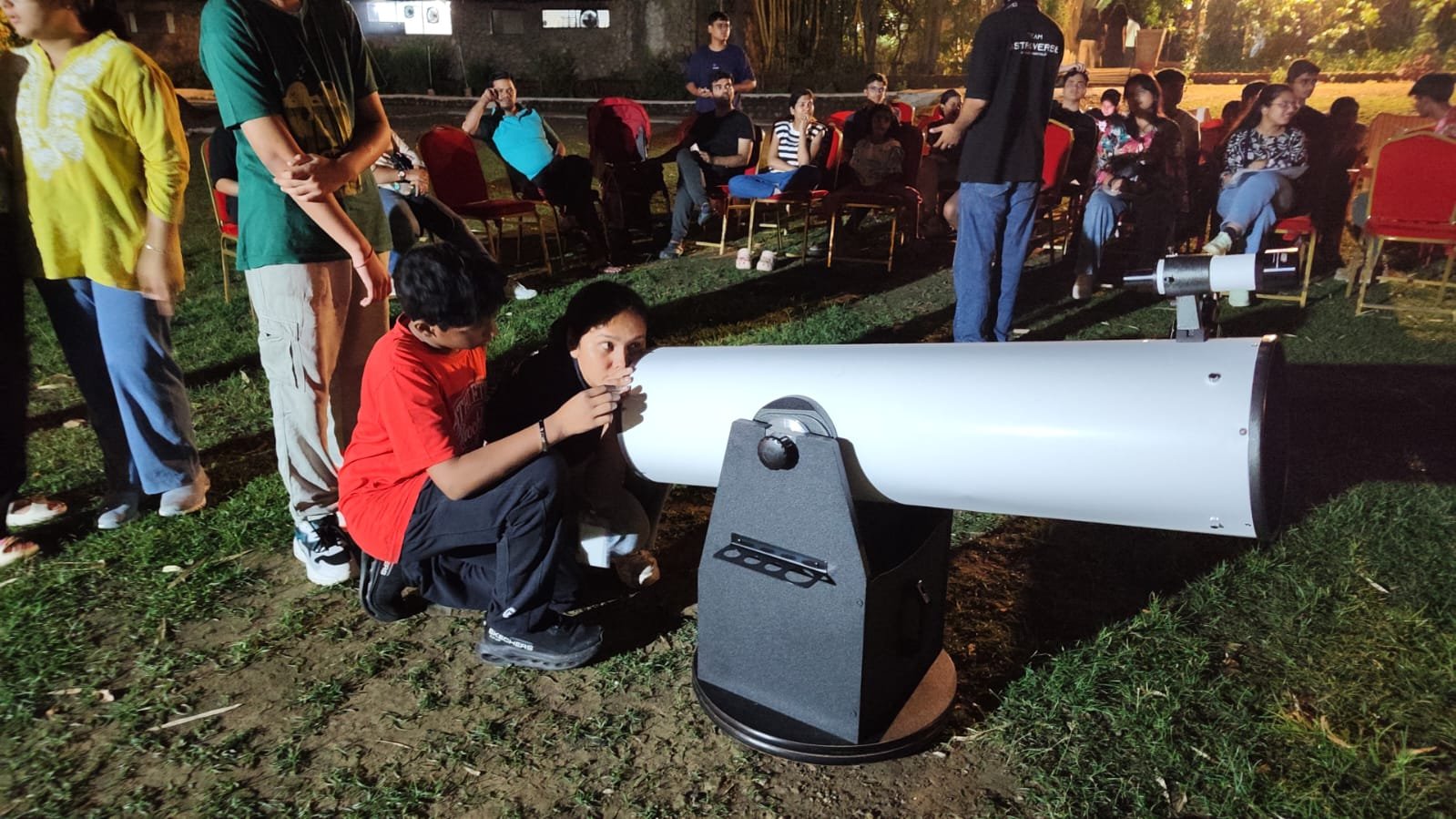
As evening approaches, students enjoy refreshments before preparing for the most exciting part of the program. Under clear night skies, expert astronomy educators guide participants through a live stargazing session using professional telescopes. Students learn constellation hopping techniques, identify prominent stars and constellations visible during the season, and observe celestial objects such as the Moon, planets, star clusters, nebulae, and distant galaxies.
Conclusion
The program concludes late in the evening with students taking home practical knowledge of astronomy, observational skills, and a deeper appreciation for the wonders of the night sky through an engaging blend of science, exploration, and experiential learning.
- Practical Physics: Construct and launch Water Air Pressure Rockets.
- Space Engineering: Design Space Landers to study air resistance and safe landings.
- Celestial Navigation: Learn to read the night sky year-round using a Planisphere.
- Live Stargazing: Use professional telescopes to observe the Moon, planets, and nebulae.
- Expert Guidance: Sessions led by experienced astronomy educators.
What's Included
- All raw materials for Rocket Making and Space Lander activities.
- Planisphere star-chart kits for each participating student.
- Professional astronomical telescopes setup on the school campus.
- Expert astronomy educators and support staff for the duration of the camp.
What's Excluded
- Student meals and refreshments (typically managed by the school cafeteria).
- Transportation (as the event occurs on the school campus).
The schedule of outdoor activities, especially telescope observations, is highly dependent on clear skies and local weather conditions.
Note: In the event of overcast or rainy weather, the stargazing session will be replaced with interactive indoor virtual planetarium software demonstrations and enhanced celestial presentations.
Safety & FAQ
No, this is an in-school program. Our team brings all the necessary equipment, models, and professional telescopes directly to your school campus.
While we can't control the weather, we come prepared. If the sky is overcast, the telescope session is substituted with immersive virtual sky software (like Stellarium) on a large screen to simulate the night sky accurately.
Absolutely. We use safe, water-and-air pressurized rockets made from plastic bottles. Launches are conducted in a cleared open area (like a football field) under strict supervision.