10 Best Educational Travel Programs for Students: Learning Beyond the Classroom
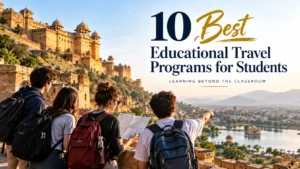 Education does not have to be limited to classrooms, textbooks, and examinations. Some of the most memorable lessons happen when students step outside their familiar surroundings and experience history, science, nature, culture, and technology in the real world. That is exactly what educational travel programs are designed to achieve.
From exploring centuries-old forts and understanding wildlife conservation to studying Himalayan geography and experiencing space science at NASA, educational travel gives students opportunities to observe, question, participate, and learn.
For schools, the right educational journey can complement classroom subjects while also encouraging independence, teamwork, curiosity, communication, and cultural awareness.
Here are 10 of the best educational travel programs for students, covering heritage, STEM, wildlife, sustainability, adventure, geography, and international learning experiences.
What Are Educational Travel Programs?
Educational travel programs are structured journeys designed around specific learning objectives rather than sightseeing alone.
These programs may connect with subjects such as history, geography, environmental science, astronomy, technology, architecture, wildlife conservation, culture, and social studies.
For example, students reading about Mughal architecture can see the Taj Mahal and Agra Fort in person. A lesson about biodiversity becomes more meaningful when students observe ecosystems inside a national park. Similarly, students interested in science and engineering can gain a completely different perspective by visiting space and technology centres.
The purpose is simple: turn destinations into classrooms and experiences into lessons.
Why Are Educational Travel Programs Important for Students?
A well-planned educational tour can help bridge the gap between theoretical knowledge and practical understanding.
Rather than memorising information only for examinations, students can see how concepts work in real environments.
Educational travel can also encourage students to become more observant and curious. Travelling together develops communication, teamwork, adaptability, responsibility, and confidence.
Different destinations can provide different learning outcomes, which is why schools should select educational travel programs for students according to their age, curriculum, interests, and educational objectives.
1. Jaipur & Ranthambore Educational Travel Program
Learning Focus: History, Wildlife Conservation, Culture & Sustainability
Jaipur and Ranthambore offer an excellent combination of heritage education and environmental learning.
In Jaipur, students can explore magnificent monuments such as Amer Fort and City Palace while learning about Rajasthan’s royal history, architecture, art, and cultural traditions. Visits to places such as a traditional handmade paper factory can also introduce students to craftsmanship, recycling, and sustainable production methods.
The learning experience changes dramatically in Ranthambore, where students enter a natural ecosystem and discover the importance of wildlife and habitat conservation.
A safari through Ranthambore National Park provides an opportunity to observe flora and fauna while understanding why protected areas play an important role in conserving India’s natural heritage. The existing Shikhar program combines heritage, handicrafts, wildlife conservation and cultural experiences.
For schools looking for educational travel programs combining history and environmental studies, Jaipur and Ranthambore make an excellent choice.
Explore: Jaipur & Ranthambore Educational Tour
2. Golden Triangle Educational Travel Program
Learning Focus: History, Architecture, Culture, Civics & STEM
Delhi, Agra, and Jaipur together create one of India’s most diverse educational journeys.
Students can study different periods of Indian history while visiting landmarks connected to architecture, governance, science, transport, art, and culture.
Delhi introduces students to India’s historical and modern capital through attractions such as Qutub Minar, the National Rail Museum, and Nehru Planetarium. In Agra, visits to the Taj Mahal and Agra Fort bring Mughal history and architecture to life.
The journey then continues to Jaipur, where students can explore Rajput architecture, traditional handicrafts, museums, cultural experiences, and sustainable production techniques.
Shikhar’s Golden Triangle program combines History, Civics, STEM and Cultural Studies, including visits to historical monuments, a planetarium, museum and traditional manufacturing facilities.
This makes the Golden Triangle one of the most versatile educational travel programs for school students in India.
Explore: Golden Triangle Educational Tour
3. Orchha, Panna National Park & Agra Educational Program
Learning Focus: Adventure, Biodiversity, History & Architecture
The Orchha–Panna–Agra route brings together three very different forms of experiential education.
At Orchha, students can explore Bundela architecture while participating in supervised adventure and team-building activities. Activities such as obstacle courses, tent pitching and outdoor challenges can encourage teamwork, leadership, coordination, resilience, and problem-solving.
Panna National Park provides an entirely different classroom.
Students can observe forest ecosystems and learn about biodiversity, wildlife management and conservation. Shikhar’s program introduces students to the region’s dry deciduous forests and wildlife while connecting the safari experience with lessons on ecosystem management and conservation.
The journey to Agra adds another layer of learning through Mughal heritage and architecture.
This combination makes it particularly valuable for schools seeking educational travel programs that integrate adventure, nature and history.
Explore: Orchha, Panna National Park & Agra Educational Tour
4. Jodhpur & Jaisalmer Educational Travel Program
Learning Focus: Desert Geography, Heritage, Architecture & Culture
The Thar Desert can become an extraordinary geography classroom.
A student journey through Jodhpur and Jaisalmer allows young travellers to understand how people, settlements, architecture, livelihoods and traditions have adapted to an arid environment.
Historic forts, havelis and traditional neighbourhoods reveal Rajasthan’s architectural heritage, while the desert landscape provides opportunities to discuss climate, water scarcity, vegetation, landforms, and human adaptation.
Places such as Jaisalmer Fort, Patwon Ki Haveli, Gadisar Lake and traditional desert settlements can encourage discussions extending beyond history into geography and environmental studies.
Rather than experiencing Rajasthan only as tourists, students can begin to understand the relationship between environment, culture and human civilisation.
Explore: Jodhpur & Jaisalmer Educational Tour
5. Manali Educational Travel Program
Learning Focus: Himalayan Geography, Environment, Adventure & Teamwork
For students studying geography and environmental science, the Himalayas offer lessons that no textbook can fully recreate.
A Manali educational tour introduces students to mountain landscapes, river systems, vegetation, local communities and Himalayan environments.
Outdoor experiences can also be incorporated into the journey to strengthen teamwork, communication, confidence and leadership.
For geography students, observing mountains, valleys, rivers and changing vegetation directly can make concepts such as altitude, climate and ecosystems easier to understand.
This balance of academic observation and outdoor learning makes Manali particularly suitable for schools seeking educational travel programs with adventure and environmental learning.
Explore: Manali Educational Tour
6. Beas Kund Himalayan Expedition
Learning Focus: Geography, Ecology, Adventure, Leadership & Outdoor Education
Some lessons are best learned on foot.
The Beas Kund Himalayan Expedition provides students with the opportunity to experience mountain environments while developing important personal and social skills.
As students trek through Himalayan terrain, they can observe changes in vegetation, landscapes, water systems and altitude. Such journeys can help make subjects including geography, ecology and environmental science more tangible.
The expedition environment can also encourage students to manage challenges, support classmates, follow instructions, communicate as a team and develop greater personal responsibility.
For older students, trekking-based educational travel programs can be particularly effective because they combine academic observation with physical activity, leadership and character development.
Explore: Beas Kund Himalayan Expedition
7. NASA USA STEM Educational Travel Program
Learning Focus: Space Science, STEM, Aerospace & Innovation
For students fascinated by science and technology, a NASA educational journey can turn curiosity about space into a powerful real-world learning experience.
Shikhar’s NASA USA program includes exposure to the Kennedy Space Center alongside destinations such as New York, Washington D.C., Niagara Falls and Orlando. The program is designed around space exploration, science, technology, history and global culture.
Students interested in physics, engineering, robotics, aerospace and future technologies can gain valuable exposure to how scientific ideas are transformed into real missions and technologies.
Space-based international educational travel programs can also encourage students to think about future careers in science, engineering, research and innovation.
Beyond technical knowledge, travelling internationally gives students valuable cultural exposure and a broader understanding of the world.
8. Singapore Educational Travel Program
Learning Focus: Innovation, Sustainability, Science & Global Education
Singapore provides an excellent example of how urban development, sustainability, technology and education can come together.
Students can explore environmental planning at Gardens by the Bay, understand biodiversity and wildlife conservation, study urban infrastructure, and visit science and educational institutions.
Depending on institutional approval, Shikhar’s Singapore program may also incorporate interaction with a local school or university. Alternatives include educational visits to attractions such as Science Centre Singapore or facilities connected with sustainable water management.
The program therefore extends beyond conventional sightseeing.
Students can observe how a modern city approaches environmental management, public infrastructure, technology and multicultural living.
Singapore is particularly suitable for schools searching for educational travel programs abroad that combine STEM, sustainability and international exposure.
9. Corbett Astro Science Educational Program
Learning Focus: Astronomy, Science, Nature & Adventure
Educational travel does not always need to involve long-distance international journeys.
A science-focused outdoor camp can provide highly engaging learning opportunities close to nature.
The Corbett Astro Science Camp combines astronomy with natural surroundings and adventure. The program includes introductory astronomy sessions covering planets, stars, galaxies and the universe, helping students explore space science beyond their normal classroom environment.
Activities around astronomy encourage students to ask questions, observe the night sky and connect theoretical concepts with practical experiences.
Combining science with outdoor activities can be particularly effective for younger learners because it keeps the program interactive and discovery-led.
For schools looking for shorter educational travel programs for students, astronomy and science camps can provide a strong combination of learning and recreation.
10. Norway Educational Travel Program
Learning Focus: STEM, Sustainability, Climate & Global Learning
Norway offers an entirely different educational environment for students interested in sustainability, climate studies, science and global development.
Shikhar’s Norway educational program connects Nordic cities, academic institutions, cultural heritage and Arctic environments. Its curriculum focus includes STEM, sustainability, climate awareness and indigenous culture.
Students can explore questions such as how cities approach sustainability, how communities adapt to northern environments, how climate influences society, and how innovation shapes modern lifestyles.
International educational travel programs like Norway can help students understand that global issues such as sustainability and climate change are connected to geography, technology, culture, public policy and everyday life.
For senior school students, this type of interdisciplinary journey can encourage deeper discussion and global awareness.
How Educational Travel Programs Support Classroom Learning
The strongest educational tours do not replace classroom teaching. They strengthen it.
History becomes more memorable when students stand inside a centuries-old fort.
Geography becomes easier to understand while observing mountains, deserts and rivers.
Environmental science becomes more meaningful inside a national park.
Astronomy creates greater curiosity when students observe the night sky.
STEM education becomes more inspiring when students see how engineering, robotics and technology operate outside textbooks.
This is why carefully designed educational travel programs for students should begin with learning objectives rather than simply a list of tourist attractions.
How to Choose the Right Educational Travel Program for Your School
Every student group is different, so schools should consider several factors before selecting a destination.
Curriculum Connection
Choose destinations and activities that complement subjects students are currently studying.
Age and Grade
Activities suitable for senior students may not be appropriate for younger groups. Physical difficulty, travel duration and the complexity of learning activities should be considered.
Learning Outcomes
Define what students should understand, experience or develop by the end of the journey.
Safety and Supervision
Student safety should be a central consideration, including transport, accommodation, activities, destination management and group supervision.
Duration and Budget
The program should provide meaningful learning while remaining practical for the school’s available time and budget.
Student Engagement
Look for interactive activities, workshops, demonstrations, field visits and hands-on experiences instead of building the entire itinerary around passive sightseeing.
Domestic vs International Educational Travel Programs
Both domestic and international programs can provide excellent educational value.
Domestic educational travel programs can introduce students to India’s history, biodiversity, geography, architecture, communities and cultural diversity. Destinations such as Rajasthan, Madhya Pradesh, Himachal Pradesh and Uttarakhand can support curriculum-based learning without requiring international travel.
International educational travel programs, on the other hand, provide additional exposure to global cultures, technologies, education systems, sustainability practices and different ways of life.
The right choice depends on student age, academic objectives, available time, budget and the learning outcomes expected by the school.
Turning Travel into Meaningful Student Learning
The real value of an educational journey is not measured by how many places students visit.
It is measured by what they understand, experience and remember after returning to school.
A student who has watched wildlife inside a protected forest may better understand conservation. A child who has walked through a historic fort may become more interested in history. A student who experiences NASA may begin thinking seriously about science or engineering.
That is why well-designed educational travel programs can become an important extension of classroom education.
Educational Travel Programs with Shikhar Educational Tours
Shikhar Educational Tours, a division of Shikhar Travels (India) Pvt. Ltd., has been organizing educational and special-interest journeys since the company was established in 1979. Its educational programs cover India and international destinations and are designed around experiential learning, cultural understanding, academic exposure and professionally managed student travel.
Programs can be planned around themes such as:
- History and heritage
- Science and technology
- Space and astronomy
- Geography and environment
- Wildlife and conservation
- Adventure and leadership
- Industrial learning
- Culture and community
- Sustainability
- International education and exposure
Rather than treating every school group in the same way, an educational journey can be designed according to the students’ age group, academic objectives, destination preference, duration and group requirements.
Plan an Educational Travel Program for Your Students
The world can become one of the most powerful classrooms available to young learners.
Whether your students are exploring Rajasthan’s heritage, observing wildlife in a national park, trekking through the Himalayas, discovering astronomy under the night sky, studying sustainability in Singapore or exploring space science at NASA, the right journey can transform learning into experience.
Explore educational travel programs with Shikhar Educational Tours and create a learning journey designed around your school’s academic goals, student interests and travel requirements.
Follow Us & Travel With Us
Get travel inspiration, exciting destinations, tour updates & special offers.
Frequently Asked Questions
1. What are educational travel programs?
Educational travel programs are structured tours or journeys designed to combine travel with academic, cultural, scientific, environmental or experiential learning. They may include museum visits, heritage sites, science centres, wildlife reserves, industrial visits, workshops and outdoor activities.
2. What are the best educational travel programs for students?
The best program depends on the student’s age and learning objectives. Popular options include heritage tours, wildlife programs, STEM tours, NASA programs, geography field trips, adventure camps, international immersion programs and sustainability-focused tours.
3. How do educational travel programs benefit students?
Educational travel allows students to connect classroom knowledge with real-world situations. It can also encourage curiosity, teamwork, independence, communication, confidence, cultural understanding and problem-solving skills.
4. Are educational travel programs suitable for school groups?
Yes. Programs can be designed specifically for school groups according to age, curriculum, group size, duration, safety requirements and educational objectives.
5. What is the difference between an educational tour and a regular school trip?
A regular trip may focus mainly on recreation and sightseeing. An educational tour is structured around defined learning outcomes and incorporates activities, destinations and experiences that support academic or personal development.