Importance of Educational Tours: Benefits, Learning Outcomes & Why They Matter
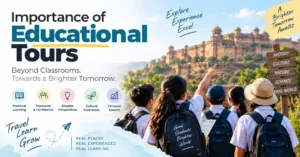 Education does not have to remain limited to classrooms, textbooks, and examinations. Some of the most memorable lessons happen when students step outside the classroom and experience places, people, cultures, and real-world situations firsthand. This is why the importance of educational tours has become increasingly recognized by schools, teachers, and parents.
Educational tours give students an opportunity to connect theoretical knowledge with practical experiences. A history lesson becomes more meaningful when students visit a historical monument. A science topic becomes easier to understand when they see scientific principles demonstrated in a real environment. Similarly, geography, culture, environmental studies and social sciences can become much more engaging through carefully planned educational visits.
Beyond academic learning, educational tours can also support communication, teamwork, confidence, independence, and social development. When thoughtfully designed, a school trip is not simply a break from regular classes—it can become an extension of the learning environment.
What Is an Educational Tour?
An educational tour is a planned visit to a destination, institution, historical site, museum, nature reserve, industry, research center, or other location with a specific learning objective.
Unlike a recreational trip, an educational tour is generally connected to the curriculum or broader learning goals. Students may participate in guided tours, workshops, demonstrations, field studies, cultural activities, discussions and observation-based assignments.
For example, students studying Indian history might visit historical monuments and museums, while students learning about environmental science could visit national parks, biodiversity centers, or ecological sites.
The central purpose is learning through direct experience.
Why Are Educational Tours Important?
The importance of educational tours comes from their ability to transform abstract information into experiences that students can see, hear and interact with.
Classroom education provides essential theoretical knowledge, but real-world exposure can help students understand how that knowledge applies outside school.
Educational tours can:
- Make learning more engaging
- Connect classroom lessons with real-world situations
- Improve observation and analytical skills
- Encourage curiosity and questioning
- Develop communication and teamwork
- Introduce students to different cultures and environments
- Build confidence and independence
- Create memorable learning experiences
The value of an educational tour therefore extends beyond sightseeing. Its effectiveness depends on how well the destination, activities and learning objectives are connected.
1. Educational Tours Connect Theory With Practical Learning
One of the biggest benefits of educational tours is the opportunity to connect theoretical knowledge with practical experience.
A textbook can describe how a historical site was constructed, how an ecosystem functions or how an industrial process works. During an educational visit, students can observe these concepts in context.
For instance, students studying architecture can examine the design of historical buildings, while geography students can observe landscapes and environmental features directly.
This connection between theory and experience can make difficult concepts easier to understand and remember.
2. Educational Tours Make Learning More Engaging
Traditional classroom learning has an important role, but students can sometimes find repetitive lessons difficult to engage with.
Educational tours introduce movement, exploration and discovery into the learning process.
Instead of simply reading about a subject, students can interact with their surroundings and ask questions based on what they observe.
A museum visit, science centre, historical monument or cultural destination can turn a conventional lesson into an experience that students are more likely to remember.
This is an important reason why the importance of educational tours goes beyond academic marks.
3. They Encourage Experiential Learning
Experiential learning means learning through direct experience, reflection and participation.
Educational tours naturally create opportunities for this approach. Students can observe, investigate, discuss and reflect on what they encounter.
For example, during an environmental field trip, students might:
- Observe local plants and animals.
- Record environmental conditions.
- Discuss ecological relationships.
- Ask questions to experts or teachers.
- Reflect on how human activity affects the environment.
Such experiences can encourage students to become active participants in their own learning rather than passive recipients of information.
4. Educational Tours Improve Observation and Critical Thinking
A well-designed educational tour encourages students to look beyond what is immediately visible.
Teachers can ask students to compare locations, identify patterns, interpret information or explain what they observe.
Suppose students visit a historical monument. Instead of simply taking photographs, they could be asked to identify architectural features, understand the historical context and consider why the monument was built in a particular way.
These activities can strengthen observation, reasoning and critical-thinking skills.
5. They Develop Communication and Teamwork
Another important aspect of educational tours is social learning.
Students travel, participate in activities and solve small problems together. They may need to communicate with classmates, teachers, guides and other people they encounter.
Group activities can teach students how to:
- Listen to others
- Share responsibilities
- Cooperate with classmates
- Express their ideas
- Resolve minor disagreements
- Work toward a common objective
These interpersonal skills are valuable not only in school but also in higher education and professional life.
6. Educational Tours Build Confidence and Independence
For many students, a school educational tour may be their first experience travelling without their parents.
Being away from their usual environment can encourage students to become more responsible and independent.
They may have to manage their belongings, follow schedules, communicate with others and make appropriate decisions within the boundaries established by teachers.
Even small responsibilities can gradually help students develop confidence.
A carefully supervised educational tour can therefore contribute to personal development while maintaining student safety and structure.
7. They Introduce Students to Different Cultures
India has an extraordinary diversity of languages, traditions, food, architecture, festivals and cultural practices.
Educational tours can help students experience this diversity directly.
A cultural tour might introduce students to local traditions, traditional crafts, historical communities or regional forms of art and music.
Such exposure can encourage students to appreciate differences and understand that communities may have different ways of living while sharing many common human values.
For international educational tours, this cultural exposure can become even broader, helping students develop global awareness.
8. Educational Tours Make History Come Alive
History is often taught through dates, events, personalities and written records. While these are important, visiting historical places can provide another dimension to the subject.
Standing inside an old fort, walking through a historic city or visiting a museum containing original artefacts can help students develop a stronger connection with the past.
For example, instead of only reading about India’s freedom movement, students could visit historically significant locations and museums where they can learn through exhibits, photographs and preserved artefacts.
This is one of the strongest examples of the importance of educational tours in academic learning.
9. They Promote Environmental Awareness
Educational tours can also help students understand environmental issues.
Visits to national parks, botanical gardens, wildlife conservation centres, wetlands or other natural environments can provide opportunities to learn about:
- Biodiversity
- Ecosystems
- Conservation
- Climate and weather
- Natural resources
- Pollution
- Sustainable development
When students see environmental systems firsthand, concepts that may seem abstract in textbooks can become more tangible.
Such experiences can encourage responsible attitudes toward nature and conservation.
10. Educational Tours Help Students Discover Career Possibilities
Educational tours can expose students to professional environments that they may otherwise never experience.
Visits to universities, laboratories, manufacturing facilities, technology centres, museums, hospitals or other institutions can introduce students to different fields of study and careers.
For older students, this can be particularly valuable.
A student interested in engineering might gain insight from visiting a technology or manufacturing facility. Another interested in science could benefit from seeing a laboratory environment.
These experiences may help students think more clearly about their future educational and career choices.
11. Educational Tours Strengthen Teacher-Student Relationships
Educational tours also create opportunities for teachers and students to interact outside the traditional classroom setting.
Teachers can observe students in different situations and understand their interests, strengths, and personalities better.
Students, meanwhile, may feel more comfortable communicating with teachers during informal educational activities.
This can contribute to a more positive learning environment when students return to school.
12. Educational Tours Create Long-Lasting Memories
One of the most powerful benefits of educational travel is that experiences often remain in students’ memories for years.
A lesson from a textbook may eventually be forgotten, but students may continue remembering the historical monument they explored, the science experiment they witnessed or the cultural experience they shared with classmates.
These memories can reinforce learning long after the trip has ended.
However, the goal should not simply be to create enjoyable memories. The strongest educational tours combine enjoyment with meaningful learning objectives.
How Can Schools Make Educational Tours More Effective?
Understanding the importance of educational tours is only the first step. Proper planning is essential to make the experience valuable.
Set clear learning objectives
Before selecting a destination, schools should determine what students are expected to learn.
Choose destinations carefully
The destination should be relevant to the students’ age, curriculum and learning goals.
Prepare students before the tour
Teachers can introduce the location, historical background or scientific concepts before the visit.
Include interactive activities
Observation sheets, quizzes, guided discussions, workshops and field assignments can make students more actively involved.
Encourage reflection afterward
After returning to school, students can prepare presentations, reports, projects or discussions based on what they learned.
This helps convert a short trip into a complete learning cycle.
Educational Tours vs. Recreational Trips
Although educational and recreational trips can both be enjoyable, their primary objectives are different.
| Educational Tours | Recreational Trips |
| Focus on learning and experience | Focus mainly on relaxation and entertainment |
| Connected to educational objectives | Usually not curriculum-based |
| Often include guided activities | Usually centred around leisure |
| Encourage observation and inquiry | Primarily encourage enjoyment |
| Include learning outcomes | Learning may be incidental |
An educational tour can certainly be enjoyable, but its success should ultimately be measured by what students experience, understand and learn.
Follow Us & Travel With Us
Get travel inspiration, exciting destinations, tour updates & special offers.
Frequently Asked Questions
What is the main importance of educational tours?
The main importance of educational tours is that they provide students with practical, real-world experiences that complement classroom learning. They can make academic concepts more meaningful while supporting social and personal development.
What are the major benefits of educational tours for students?
Major benefits include practical learning, improved observation, critical thinking, communication, teamwork, confidence, cultural awareness and greater exposure to career possibilities.
How do educational tours improve learning?
Educational tours allow students to observe and experience concepts in real environments. This can make theoretical subjects more engaging and provide context that classroom lessons alone may not provide.
Why are educational tours important for school students?
Educational tours give school students opportunities to explore the world beyond their classroom. They can support academic learning while helping students develop independence, teamwork, curiosity and communication skills.
Are educational tours useful for career guidance?
Yes. Visits to universities, laboratories, industries, museums, technology centres and professional institutions can expose students to different academic disciplines and career environments.
How should schools plan an educational tour?
Schools should begin with clear learning objectives, select an appropriate destination, plan transportation and safety arrangements, prepare students beforehand, organize meaningful activities and conduct follow-up assignments after the trip.
Conclusion
The importance of educational tours lies in their ability to turn learning into an active, practical and memorable experience. A well-planned educational tour can take students beyond textbooks and classrooms and introduce them to real places, cultures, environments, institutions and historical experiences.
From improving academic understanding to developing communication, teamwork, confidence and curiosity, educational tours can contribute to the overall development of students.
The most successful school trips are not simply about visiting attractive destinations. They are carefully designed learning experiences where students see, explore, question, participate and reflect.
When schools combine strong academic objectives with thoughtful planning, educational tours can become an important part of modern education—helping students understand that learning is not confined to a classroom. The world itself can become a classroom.