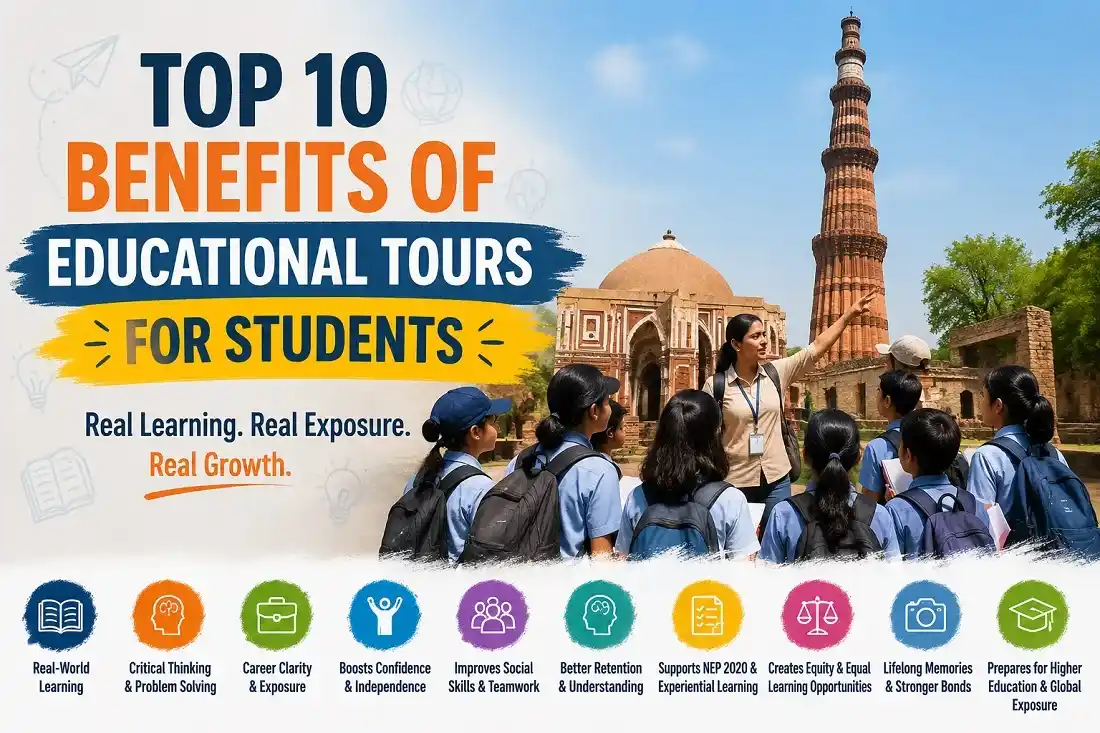
Top 10 Benefits of Educational Tours for Students
Ask any teacher who has stood at the base of Qutub Minar with thirty restless students, notebooks flapping in the wind, and they will tell you the same thing: that hour taught more than three textbook chapters.
The benefits of educational tours for students go far beyond a fun day away from the classroom — this kind of hands-on learning builds memory, confidence, and real-world understanding that lectures alone rarely achieve.
If you are a school coordinator, a parent, or a teacher trying to justify a trip budget to your principal, this guide breaks down exactly what students gain from a well-planned educational tour, backed by real classroom outcomes and current Indian education policy — not vague inspirational claims.
What Is an Educational Tour? (Quick Definition)
An educational tour is a curriculum-linked trip organised by a school or college to a site — a monument, museum, lab, or natural habitat — where students learn through direct observation and hands-on activity instead of only reading about the topic.
This style of curriculum-linked learning is different from a picnic, since it is planned around a specific learning objective and usually includes a follow-up classroom activity.
| Quick Overview
The biggest benefits of educational tours for students are stronger critical thinking, better retention, career clarity, and social confidence, built by connecting textbook concepts to real, physical experiences. Research on museum and field-trip programs shows the gains in critical thinking and cultural understanding are strongest for students from smaller towns and first-time travelers — turning a single trip into a genuine equalizer, not just a school outing. |
Key Takeaways
- Educational tours turn abstract textbook concepts into hands-on, memorable learning.
- NEP 2020 formally encourages field visits and experiential learning as core pedagogy, not an extracurricular add-on.
- Students from smaller towns or first-generation travelers tend to gain the most from structured tours.
- Well-planned tours build teamwork, independence, and confidence alongside academic value.
- The right operator handles safety, permissions, and itinerary design so teachers can focus on learning outcomes.
Why Educational Tours Are Important for Students: Top Benefits
Here is what actually changes for a student who goes on a genuine educational tour — not a shopping trip disguised as one.
Understanding why educational tours are important for students starts with looking at what each trip actually trains: attention, curiosity, and the ability to connect what’s in a book to what’s in front of them.
Top 10 Benefits at a Glance
- Bridges classroom theory with real-world understanding
- Builds critical thinking and problem-solving skills
- Strengthens career clarity and exposure
- Boosts confidence and independence
- Improves social skills, teamwork and cultural sensitivity
- Deepens retention compared to textbook-only learning
- Supports NEP 2020’s push for experiential learning
- Creates equity — bigger gains for first-time travellers
- Builds lifelong memories and stronger teacher-student bonds
- Prepares students for higher education and global exposure
1. Bridges Classroom Theory With Real-World Understanding
A chapter on the Mughal era stays flat on paper until a student stands inside Humayun’s Tomb and sees the same architecture described in their history book. This is what educators call place-based learning — students engage with a subject directly instead of just reading about it.
For subjects like history, geography, and environmental science, this connection between theory and reality is hard to replicate inside four walls.
2. Builds Critical Thinking and Problem-Solving Skills
On a tour, students constantly evaluate what they are seeing — comparing what a guide says with what they read, questioning why a monument was built a certain way, or figuring out logistics as a group. This kind of active evaluation strengthens analytical thinking far more than passive listening in a classroom.
3. Strengthens Career Clarity and Exposure
A visit to a research lab, a heritage conservation site, or a planetarium can do what a career counselling session cannot — show a student what a profession actually looks like day to day. Many students only discover an interest in archaeology, environmental science, or hospitality after seeing it in action on an educational trip.
4. Boosts Confidence and Independence
Navigating an unfamiliar city, managing personal belongings, sticking to a schedule, and interacting with strangers — these are small responsibilities that add up. Many teachers report that students who travel with their school return more self-assured, especially those on their first trip away from family.
5. Improves Social Skills, Teamwork and Cultural Sensitivity
Shared meals, group tasks, and long bus rides do more for classroom bonding than any icebreaker activity. Tours that include interaction with local communities also build cultural sensitivity — students learn to respect customs and traditions different from their own, a skill that matters well beyond school.
6. Deepens Retention Compared to Textbook-Only Learning
Information tied to a physical, emotional experience tends to stick. A student who touched a fossil at a natural history museum or measured water quality in a local stream is more likely to recall that lesson years later than one who only read about it.
This is the core logic behind David Kolb’s experiential learning theory, which holds that people learn best by doing, reflecting, and applying — not by passively receiving information.
7. Supports NEP 2020’s Experiential Learning Push
India’s National Education Policy 2020, released by the Ministry of Education, strongly encourages experiential, inquiry-based, and field-based learning over rote memorisation — it does not mandate tours specifically, but it clearly favours this style of hands-on teaching.
Schools that organise structured educational tours are not just enriching students — they are aligning with the direction Indian education policy is heading.
8. Creates Equity — Bigger Gains for First-Time Travellers
A widely cited randomized study by University of Arkansas researchers Greene, Kisida and Bowen (2014) tracked over 10,000 students who took a single field trip to an art museum. Gains in critical thinking, historical empathy, and tolerance were consistently larger for students from rural and high-poverty schools than for students who already travelled often.
In that study’s tolerance measure specifically, rural students’ improvement was equal to about 13% of a standard deviation, and high-poverty-school students’ improvement was about 9% — a research way of showing the effect was real and larger for students with less prior travel exposure.
For many Indian students too, a school tour is their only chance to see a monument, a lab, or a city outside their hometown.
9. Builds Lifelong Memories and Stronger Teacher-Student Bonds
Ask any adult about their most memorable school moment, and there is a good chance it involves a trip, not a test. Tours give teachers and students a shared, informal setting to connect — something that rarely happens inside a strict classroom routine.
Many educators find this shared experience often improves classroom relationships long after the trip ends, even though the effect naturally varies by group and trip.
10. Prepares Students for Higher Education and Global Exposure
Students who are used to structured travel, unfamiliar environments, and group coordination adapt faster to college life, hostel living, and eventually study-abroad opportunities. An educational tour in school is often a student’s first low-risk practice run for independence.
Benefit-to-Skill Snapshot
| Benefit | Skill or Outcome Developed |
|---|---|
| Real-world understanding | Applied subject knowledge |
| Critical thinking | Analysis and evaluation |
| Career exposure | Informed subject/stream choices |
| Confidence and independence | Self-management, decision-making |
| Teamwork and cultural sensitivity | Collaboration, empathy |
What Actually Happens on a Well-Run Educational Tour
How Educational Tours Help Students Learn Better On the Ground
Most schools we work with underestimate how much planning separates a good educational tour from a chaotic one. During peak season — October to March for most of North India — the best slots at heritage sites and museums fill up weeks in advance.
A rushed itinerary usually means students spend more time waiting than learning. Good planning is what actually turns a trip into classroom to real-world learning, rather than just a day out.
Morning visits work better than afternoon ones. Sites like the Red Fort or Qutub Minar are quieter before 11 AM, guides are more attentive with smaller crowds, and students stay more focused before the day gets hot and tiring.
Local coordinators usually recommend keeping each site visit under 90 minutes with a structured activity — a worksheet, a quiz, or a group task — because unstructured time is where engagement drops fastest.
One mistake many schools make is packing five sites into a single day. Students remember two sites covered well far better than five covered in a rush.
Types of Educational Tours for Students in India
The benefits of educational tours for students also depend on the type of tour chosen — not every trip looks the same, and matching the format to the subject and age group makes a big difference to how much students actually take away from it.
School tours in India generally fall into a few broad categories, each suited to different learning goals:
- Heritage & Cultural Tours — monuments, forts, and museums that bring history and civics chapters to life (e.g., Delhi’s Red Fort, Humayun’s Tomb, Qutub Minar, National Museum).
- Science & STEM Tours — science centres, planetariums, and research facilities such as National Council of Science Museums (NCSM) centres that support physics, chemistry, and biology curricula.
- Space & Institutional Visits — exposure visits linked to institutions like ISRO or CSIR labs, and industrial or media houses that give students real career exposure.
- Nature & Environmental Tours — wildlife sanctuaries, botanical gardens, and eco-parks that support environmental science lessons.
- Adventure & Himalayan Educational Treks — structured trekking programmes that build discipline, teamwork, and physical resilience alongside geography learning.
- International Exposure Tours — for senior students, short study tours abroad that build global awareness and language exposure.
Objectives of Educational Tours
Beyond the day-to-day benefits, the importance of educational tours becomes clear when you look at why most schools plan educational trips for students around a few core objectives, often reflected in NCERT-aligned curricula and NEP 2020’s push for experiential learning.
- Academic objective — reinforcing classroom concepts through direct observation.
- Social objective — building teamwork, communication, and group discipline.
- Cultural objective — exposing students to heritage, diversity, and local traditions.
- Career objective — giving students early exposure to real professions and institutions.
- Personality development — building confidence, independence, and adaptability.
Benefits by Group: Students, Teachers, Schools & Parents
Educational tours don’t just benefit students — the value shows up differently for everyone involved in planning and running one.
Benefits for Teachers
Teachers get an informal setting to observe students beyond test scores, spot hidden strengths, and build rapport that carries back into the classroom.
Benefits for Schools
Schools strengthen their academic reputation, demonstrate NEP 2020-aligned experiential teaching, and often see improved student engagement in the weeks after a well-run tour.
Benefits for Parents
Parents get visible proof of practical learning beyond marksheets, plus a low-risk way for their child to build independence under school supervision.
Educational Tours vs Virtual Learning in 2026
With virtual field trips, AR/VR museum tours, and video content easily available, some schools ask if a physical tour is still worth the effort. It usually is.
- Virtual learning is convenient and low-cost but stays passive — students watch rather than experience.
- Physical tours add sensory, social, and emotional context that screens cannot fully replicate.
- The strongest approach for many schools is hybrid: virtual previews before the trip, followed by an in-person visit for depth.
Safety & Compliance Guidelines for School Educational Tours in India
This is the part schools cannot afford to skip, and it is where a registered operator genuinely earns its fee. According to a CBSE circular on school study tours, affiliated schools must ensure that any study tour is directly linked to the curriculum and is not purely recreational.
- Curriculum relevance: the head of the institution must confirm the tour benefits students and connects to their course of study.
- Government intimation: for visits to sensitive sites such as dams, power plants, or beaches, the same CBSE circular requires schools to send written communication to the District Magistrate or concerned local authority in advance.
- Registered operator requirement: per CBSE guidance, for a study tour of more than 10 students, schools must engage one registered local tour operator.
- General child-safety compliance: schools are also expected to follow the National Disaster Management Authority’s School Safety Policy, 2016, and related student-safety guidelines during off-campus activities.
- Travel and accident insurance: many schools now include basic group travel or accident insurance as part of the tour package — worth confirming before departure.
- Medical readiness: carry a simple medical checklist per student — known allergies, regular medication, blood group, and emergency contact details.
- Supervision ratio: schools commonly assign roughly one accompanying teacher per 10-15 students, adjusted for younger age groups or higher-risk sites.
Working with a government-recognised operator like Shikhar Educational Tours means these compliance steps — permissions, operator registration, and safety planning — are handled as a standard part of the itinerary, not an afterthought.
Classroom Learning vs Educational Tour Learning
| Aspect | Classroom-Only Learning | Educational Tour Learning |
|---|---|---|
| Engagement | Passive, lecture-based | Active, hands-on, exploratory |
| Retention | Depends on repetition and revision | Reinforced by physical, emotional experience |
| Skill building | Subject knowledge mainly | Knowledge plus teamwork, confidence, independence |
| Career exposure | Limited to textbooks and talks | Direct exposure to real sites, labs, professionals |
| NEP 2020 alignment | Partial | Directly supports experiential learning goals |
How Schools Plan an Effective Educational Tour: Step-by-Step
- Define the learning objective first — pick a destination that connects directly to the curriculum, not just a popular spot.
- Shortlist 2-3 sites maximum for a single-day tour so students absorb more instead of rushing.
- Confirm group size, transport, and safety requirements with a registered tour operator experienced in school groups.
- Get written parental consent and share a detailed itinerary, including timings and emergency contacts.
- Assign teacher-to-student supervision ratios and brief accompanying staff on their roles in advance.
- Prepare a pre-trip briefing and a simple worksheet or quiz to keep students engaged on-site.
- Plan a short post-trip activity — a presentation, essay, or discussion — to reinforce what was learned.
Cost, Timeline and Booking Requirements
Educational tour pricing depends heavily on destination, group size, transport mode, and duration — a half-day Delhi heritage tour costs far less than a multi-day Himalayan or pan-India educational circuit. Most schools finalise domestic educational tours 4-6 weeks in advance, and popular sites during the October-March season should ideally be booked even earlier.
- Half-day city heritage tours: shortest planning window, lowest cost per student.
- Full-day multi-site tours: moderate planning window, transport and permits need early confirmation.
- Multi-day educational circuits (Delhi-Agra-Jaipur or Himalayan educational treks): book at least 6-8 weeks ahead, especially in peak season.
Typical Duration and Best Season
- Half-day tour: roughly 4-5 hours, ideal for a single nearby site.
- Full-day tour: roughly 8-10 hours, fits 2-3 related sites comfortably.
- Multi-day circuit: 2-7 days, used for multi-city or Himalayan educational trips.
- Best months: October to March, when weather across most of North India is stable.
- Avoid or plan carefully around: peak summer heat (May-June), heavy monsoon weeks for outdoor/trekking tours, and the board exam period for senior classes.
| Booking Tip
Peak season (October to March) fills up fast for Delhi’s major heritage sites and museums. Advance booking is strongly recommended for groups above 30 students to secure guided-entry slots and avoid long queues. |
Challenges and Limitations of Educational Tours (And How to Manage Them)
A fair, balanced view matters here — field trips for students are not automatically successful just because they happen. Common challenges include:
- Cost — manage by choosing shorter, closer destinations for budget-limited groups.
- Weather disruptions — build a backup indoor site into the plan for outdoor-heavy itineraries.
- Logistics and crowd control — solve with smaller sub-groups and a fixed teacher-to-student ratio.
- Travel fatigue — avoid by not overpacking the itinerary; two well-covered sites beat five rushed ones.
- Uneven learning outcomes — prevent by tying the trip to a clear pre-trip briefing and post-trip activity, not just a day out.
Common Mistakes Schools Make While Planning Educational Tours
- Overpacking the itinerary with too many sites in one day, leaving no time to actually absorb anything.
- Skipping a pre-trip briefing, so students don’t know what to look for or why the site matters.
- Choosing an untrained or unregistered local operator to save cost, which risks safety and site-access delays.
- Not assigning clear supervision groups, making it hard to track students at crowded sites.
- Treating the tour as purely recreational instead of tying it back to a classroom follow-up activity.
Pro Tips for Maximising Learning on an Educational Tour
- Give each student a specific question to answer during the visit — it keeps attention focused even in a large group.
- Rotate small groups with different guides or stations if the group size is large, rather than one guide for fifty students.
- Carry printed maps or fact sheets — mobile networks can be unreliable inside older monuments and rural sites.
- Schedule a short reflection session on the way back, while the experience is still fresh.
- Pair younger or first-time travellers with more experienced students to ease nervousness.
Why Choose Shikhar Educational Tours
Shikhar Educational Tours is a Government of India recognised, National Tourism Award-winning operator with sustained, on-ground experience planning school and college educational tours across India — from single-day Delhi heritage circuits to multi-day cultural and Himalayan educational trips.
- Government-registered and recognised tour operator.
- Experience coordinating large student groups with proper safety and supervision planning.
- Custom itineraries built around curriculum and learning objectives, not generic sightseeing.
- Transparent pricing with no hidden charges, plus dedicated support during the trip.
- Established relationships with heritage sites and museums that help streamline group entry.
If you are planning this seriously for the upcoming academic session, reaching out early gives the most flexibility on dates, pricing, and site availability.
Frequently Asked Questions
What is an educational tour?
A curriculum-linked school trip where students learn through direct observation and hands-on activity, not just textbooks.
What is the purpose of educational tours?
To connect classroom learning with real-world experience, building academic, social, and personal skills together.
What are the objectives of educational tours?
Academic reinforcement, social skill-building, cultural exposure, career awareness, and personality development.
What is experiential learning?
Learning by doing and reflecting on direct experience, rather than only reading or listening — the idea behind Kolb’s learning theory.
What are the main benefits of educational tours for students?
Educational tours build critical thinking, retention, career awareness, and confidence by connecting textbook learning to real-world experience.
Are educational tours compulsory for students?
No — they are optional but strongly recommended, and most schools treat them as a core part of experiential learning.
How many educational tours should a school organise per year?
Most schools plan 1-2 per class per academic year, often one local and one multi-day trip.
What are the disadvantages of educational tours?
Cost, weather risk, and logistics are the main challenges — manageable with careful planning and a registered operator.
Are educational tours safe for students?
Yes, when planned with a registered operator, proper supervision ratios, parental consent, and safety compliance.
How much does an educational tour typically cost?
Cost varies by destination, duration, and group size; half-day city tours cost far less than multi-day circuits.
At what age should students start going on educational tours?
Most schools start short local tours around age 8-10, moving to multi-day tours once students can manage longer, structured travel.
How long should a school educational tour be?
A single destination works as a half-day or full-day trip; multi-city circuits typically run 3-6 days depending on class level.
What is the ideal group size for an educational tour?
Groups of 25-40 students per batch are easiest to supervise, usually split into smaller sub-groups with dedicated coordinators.
Are educational tours only useful for history and geography subjects?
No — science labs, planetariums, wildlife sanctuaries, and industrial sites support a wide range of subjects, not just history.
How far in advance should schools book an educational tour?
4-6 weeks minimum for domestic tours, and 6-8 weeks for multi-day circuits or peak-season (October-March) bookings.
What documents are required for a school educational tour in India?
Parental consent forms, student ID proof, an emergency contact list, and, for interstate tours, school administration permission letters.
How do educational tours align with NEP 2020?
NEP 2020 strongly encourages experiential and field-based learning, making structured tours a natural fit with current policy.
Do educational tours help with career decision-making?
Yes — direct exposure to labs, heritage sites, or institutions often helps students discover interests a classroom alone cannot reveal.
What makes an educational tour different from a regular school picnic?
A tour is built around curriculum-linked objectives and follow-up activities; a picnic is mainly recreational with no defined learning outcome.
What are the different types of educational tours for students in India?
Heritage and cultural tours, science and STEM visits, nature and wildlife tours, and Himalayan educational treks are common types.
Why are educational tours important for students in 2026?
The benefits of school educational trips in 2026 matter more than ever, thanks to NEP 2020’s experiential-learning push and rising screen-based learning fatigue.
How do educational tours help students learn better than textbooks alone?
They tie facts to a physical, emotional experience, which is generally easier to recall later than information read passively.
Is prior permission required for school educational tours to sensitive sites?
Yes — CBSE guidance requires schools to inform the District Magistrate or local authority before tours to sites like dams, power plants, or beaches.
Do schools need a registered tour operator for educational trips?
For any study tour of more than 10 students, CBSE guidance recommends engaging one registered local tour operator.
Final Thoughts
Looking at the top benefits of educational tours for students in India, the takeaway is simple: these trips are not just about escaping the classroom for a day.
The benefits of educational tours for students are about giving them a version of learning that sticks, builds confidence, and often opens doors to interests they didn’t know they had.
These learning excursions matter even more for students from smaller towns or first-time travellers, for whom a well-planned tour can outweigh what students who travel often with family already have.
If your school is planning the next academic session’s educational calendar, start the conversation early. Reach out to a registered, experienced operator, define the learning objective first, and build the itinerary around it — not the other way around.