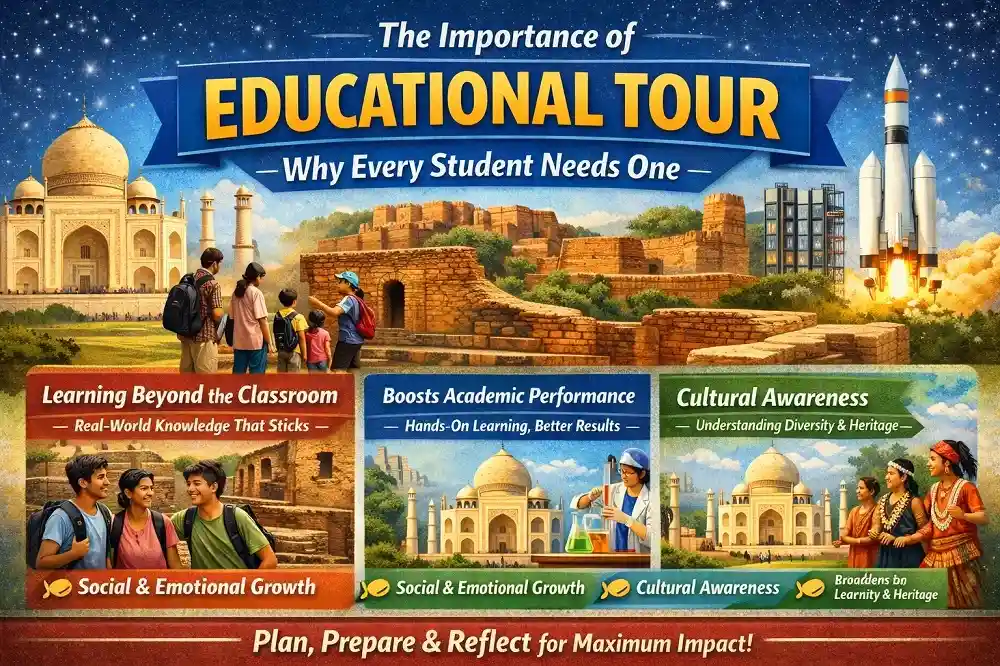
India has over 3,600 monuments protected by the Archaeological Survey of India, and 34 of them are UNESCO World Heritage Sites. For a school trip, that’s not just a list of places to visit — it’s an entire living classroom. Every fort, every cave, every abandoned city tells students something that no textbook can fully capture. The scale of a Mughal fort, the silence inside a 2,000-year-old rock-cut cave, the mathematical precision of a stone sundial — these are experiences that stay with students long after the trip is over.
Choosing the right historical places for a school trip, though, is more than just picking famous spots. The best destinations offer clear curriculum links, age-appropriate exploration, physical accessibility, and genuine wow-moments that make history feel real rather than distant. Here are the best historical places in India for school trips — covering different regions, eras, and subjects.
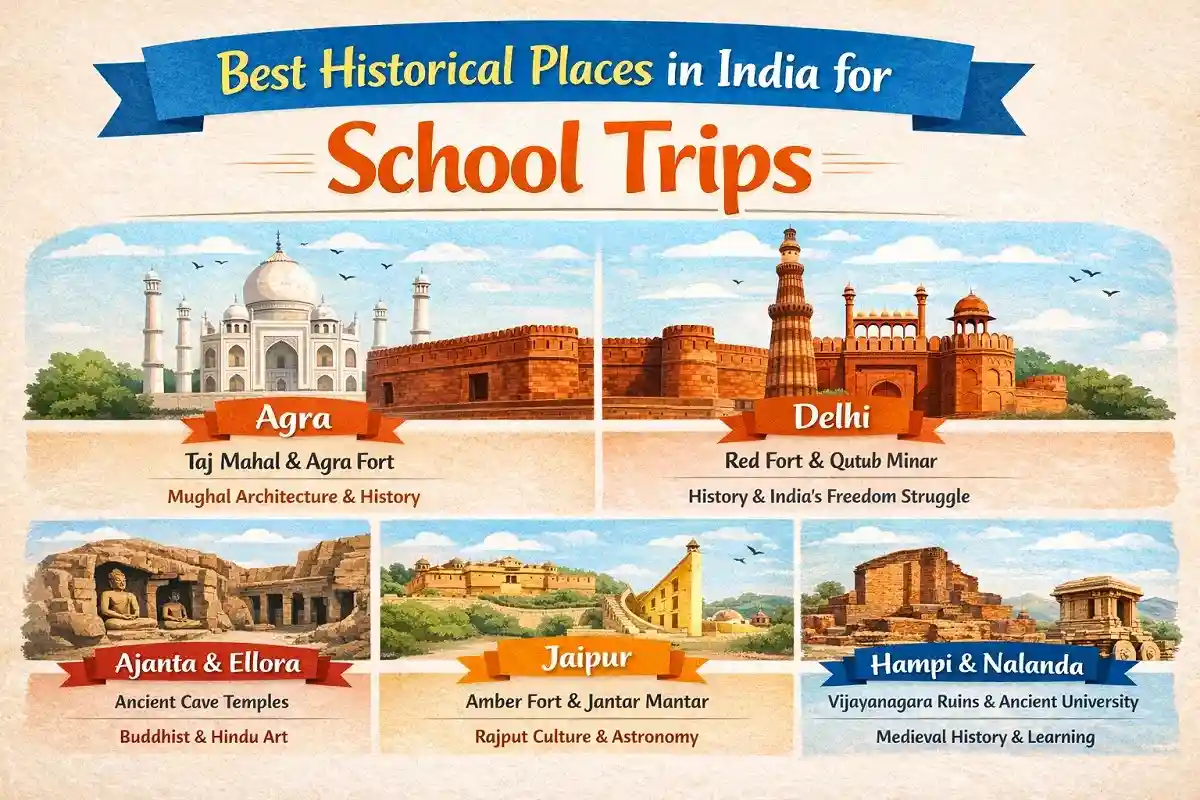
Agra — The Mughal Triangle That Teaches Three Lessons at Once
If a school could only plan one historical trip in India, Agra would be the strongest argument. The city packs three UNESCO World Heritage Sites within a 40-kilometre radius, and each one teaches something entirely different.
The Taj Mahal needs no introduction. Built by Emperor Shah Jahan between 1632 and 1653 in memory of his wife Mumtaz Mahal, this white marble mausoleum is one of the Seven Wonders of the World and the finest example of Mughal architecture ever constructed. For students, it’s a lesson in symmetry, geometry, inlay craftsmanship, and the Persian garden concept — all visible in a single afternoon. The reflective pool that perfectly mirrors the central dome, the calligraphy bands of the Quran carved into the archways, the way the marble changes colour from pink at sunrise to gold at dusk — every detail is intentional.
Just 2.5 kilometres away stands the Agra Fort, built by Emperor Akbar in red sandstone and later expanded by Shah Jahan in white marble. Abul Fazal recorded that five hundred buildings in the designs of Bengal and Gujarat were built in the fort. The human story here grips students immediately — it was inside this very fort that an imprisoned Shah Jahan spent the last eight years of his life, able to see the Taj Mahal from his window but never walk to it again. History as drama doesn’t get more compelling.
Then there’s Fatehpur Sikri, 40 kilometres west of Agra. The city was founded in 1571 and was named “Fatehpur Sikri” — the City of Victory — after Akbar’s successful Gujarat campaign in 1573. It was Akbar’s grand capital, built from scratch, and then abandoned around 1585 — likely due to water shortages. Walking through perfectly preserved palaces, the five-storey Panch Mahal, and the 54-metre-high Buland Darwaza (one of the world’s largest gateways), students can discuss urban planning, religious tolerance under Akbar, and how even powerful empires can be humbled by geography.
Best for: History, Architecture, Mughal studies, Social Science Ideal age group: Classes 5 and above
Red Fort, Delhi — Where Independence Day Lives Every Day
Delhi’s Red Fort isn’t just a monument — it’s the place where modern India began. It was the residence of several Mughal emperors and witnessed crucial moments, such as the end of Mughal rule in 1857 and India’s first Independence Day celebration in 1947, when Jawaharlal Nehru raised the tricolour atop its ramparts.
Emperor Shah Jahan commissioned the construction of the Red Fort on 12 May 1639, following his decision to shift his capital from Agra to Delhi. The design of the Red Fort is attributed to the architect Ustad Ahmad Lahori, renowned for his work on the Taj Mahal. Covering 254 acres, the fort features the Diwan-i-Aam (Hall of Public Audience), the Diwan-i-Khas (Hall of Private Audience), and the Rang Mahal among other exquisite structures.
What makes it particularly powerful for school trips is the layered history students encounter in a single campus. In the 21st century, several museums were added to the Red Fort complex. Barrack B1 is dedicated to the 1857 War of Independence, Barrack B2 commemorates the Jallianwala Bagh massacre, and Barrack B3 focuses on Subhas Chandra Bose and the Indian National Army movement. That’s the full arc of India’s freedom struggle, housed inside a Mughal fort — an arrangement that sparks spontaneous, genuine discussion among students.
The Sound and Light show at the Red Fort in the evenings is especially effective for younger students — it narrates 1,000 years of Delhi’s history through light, music, and dramatic storytelling.
Best for: History, Civics, Freedom struggle, Architecture Ideal age group: Classes 4 and above
Qutub Minar Complex, Delhi — India’s First Muslim Dynasty in Stone
The Qutub Minar is the world’s tallest brick minaret at 72.5 metres, built in the early 13th century. The Qutub Minar represents the earliest major Islamic monument in India, built by Qutub-ud-din Aibak after the conquest of Delhi in 1192.
But the real educational value for school students isn’t the tower alone — it’s the entire complex around it. The Quwwat-ul-Islam Mosque (meaning “The Might of Islam”) was the first mosque built in India after the Islamic conquest of Delhi, and it was constructed using materials from demolished Hindu and Jain temples. Students can literally see the columns and carvings of older temples repurposed into the mosque’s walls — a tangible, walking-distance lesson in how conquering powers reshape the architecture and culture of the places they take over.
Then there’s the Iron Pillar of Delhi, standing quietly in the courtyard since the 4th century CE. Despite being over 1,600 years old, it shows no significant rust — a metallurgical achievement that modern scientists have studied extensively and still find remarkable. For science and history students together, it’s a perfect cross-disciplinary moment.
Best for: History, Architecture, Science (metallurgy), Cross-disciplinary learning Ideal age group: Classes 5 and above
Ajanta and Ellora Caves, Aurangabad — Two Thousand Years of Art Underground
These two cave complexes near Aurangabad in Maharashtra are among the most astonishing things students will ever see in their lives. Both are UNESCO World Heritage Sites, and both are carved directly into hillsides — but they’re very different experiences.
The Ajanta Caves focus mainly on Buddhism, while the Ellora Caves include a variety of Buddhist, Hindu, and Jain temples. These caves showcase the artistic and architectural skills of ancient India. The Ajanta Caves, dating back to the 2nd century BCE, contain the most extraordinary surviving examples of ancient Indian painting — detailed frescoes showing royal courts, Buddhist Jataka tales, and everyday life with a sophistication that rivals Renaissance European art. The Ellora Caves, active between the 6th and 10th centuries CE, include the Kailash Temple — a single-rock structure carved downward from the top of a hill, representing Mount Kailash, and considered one of the greatest rock-cut architectural achievements anywhere in the world.
For students studying art, religion, or ancient history, these caves are incomparable. The sheer physical act of walking into spaces carved 1,500 years ago and seeing murals still vivid on the walls creates a connection to the past that no classroom can replicate.
Best for: Art history, Ancient India, Religious studies, Comparative religion (Buddhism, Hinduism, Jainism) Ideal age group: Classes 6 and above
Hampi, Karnataka — A Lost Empire Frozen in Stone
Hampi is one of the most dramatic historical sites in South India and arguably India’s most underrated school trip destination. It was the capital of the 14th-century Vijayanagara Empire, which was the world’s second-largest medieval city after Beijing.
The site sprawls across an extraordinary boulder-strewn landscape along the Tungabhadra River. Students can explore the Vittala Temple with its famous musical pillars — stone columns that produce distinct musical notes when struck — the 7th-century Virupaksha Temple, still an active place of worship, royal enclosures, market streets, elephant stables, and the iconic Stone Chariot.
The ruins of the college, spread over several hectares, consist of the remains of lecture halls, dormitories, libraries, and monasteries. What happened to Hampi is also part of the lesson — the Vijayanagara Empire was sacked by a coalition of Deccan Sultanates in 1565, and the city was looted and burned for months. Students can see the evidence of destruction alongside the surviving beauty — a powerful reminder of how civilisations rise and fall.
Best for: Medieval Indian history, Architecture, South Indian culture, Geography Ideal age group: Classes 6 and above
Jaipur, Rajasthan — Science, Royalty and Rajput Architecture Together
The Pink City offers an extraordinary range of historical learning compressed into a single city. For school trips, Jaipur covers multiple subjects simultaneously.
The Amber Fort (also called Amer Fort), built predominantly in the 16th and 17th centuries, introduces students to Rajput military architecture, the politics of the Rajput-Mughal alliance, and the elaborate system of chambers, gates, and zenanas (women’s quarters) that defined royal Rajput life.
The Jantar Mantar observatory, built by Maharaja Sawai Jai Singh II in the early 18th century, is genuinely extraordinary for students with any interest in science or astronomy. Jantar Mantar features the world’s largest stone sundial and various instruments for measuring time and celestial bodies. It’s a fascinating site for students to understand the advancements in ancient Indian astronomy. These aren’t decorative structures — they’re working instruments that produced accurate astronomical measurements centuries before modern technology. The Samrat Yantra sundial can read local time to an accuracy of two seconds.
The Hawa Mahal (Palace of Winds), with its 953 windows allowing royal women to observe street processions without being seen, is both architecturally stunning and a discussion point on gender roles in Rajput society — something that resonates differently with different age groups but always generates conversation.
Best for: History, Architecture, Science/Astronomy, Social History, Rajput culture Ideal age group: Classes 4 and above
Nalanda, Bihar — The World’s First University
For students old enough to appreciate what they’re standing in, Nalanda is one of the most intellectually moving sites in all of India. Founded in the fifth century CE, the college flourished under the patronage of various Indian dynasties and became a famous centre for learning and research in Buddhist studies, philosophy, medicine, and other topics. At its peak, Nalanda housed over 10,000 students and 2,000 teachers from across Asia, including students from China, Korea, Central Asia, and Southeast Asia. It had a library complex — called the Dharmaganja — of multiple buildings, some nine storeys high.
The ruins that students walk through today — the remains of lecture halls, monasteries, meditation cells, and stupas — all suggest a working institution of immense intellectual ambition. The Nalanda Archaeological Museum nearby houses artefacts excavated from the site. For a generation that equates universities with modern campuses, standing among these ruins and realising that this level of organised learning existed 1,500 years ago is genuinely mind-expanding.
Best for: Ancient Indian history, Buddhist studies, Education history, Critical thinking Ideal age group: Classes 7 and above
Cellular Jail, Andaman Islands — Where Freedom Struggle Becomes Personal
The Cellular Jail in Port Blair, also called Kala Pani, is the most emotionally powerful historical site on this list. Built by the British between 1896 and 1906, it was designed for solitary confinement — each prisoner isolated from every other in individual cells arranged like spokes of a wheel, able to see the wings opposite but never communicate with them.
The freedom fighters imprisoned here — including Veer Savarkar and Batukeshwar Dutt — endured conditions that the nightly Sound and Light show brings viscerally to life. Students visited the historic Cellular Jail and enjoyed a poignant sound and light show and learnt about India’s heroic freedom struggle. For students, particularly those in Classes 8 and above studying India’s independence movement, this site transforms abstract historical dates into human stories of suffering, resistance, and sacrifice. Several teachers who have taken school groups there report that the Sound and Light show produces silence among students that no classroom instruction has ever achieved.
Best for: Freedom struggle, Colonial history, Civics, Emotional learning Ideal age group: Classes 8 and above
Konark Sun Temple, Odisha — When Engineering Meets Art
The Konark Sun Temple in Odisha, built in the 13th century by King Narasimhadeva I of the Eastern Ganga dynasty, is shaped entirely like a colossal stone chariot — complete with 12 pairs of intricately carved stone wheels along its base and seven stone horses pulling the entire structure. Every wheel also functions as a sundial, capable of measuring time accurately using the shadows cast by the spokes.
Students will have the chance to appreciate ancient India’s magnificent architecture and comprehend the significance of sun worship in Indian culture through a tour to Konark. The temple’s erotic sculptures — which also cover the outer walls — are best approached with older students and require teacher preparation, but they represent a complete philosophy of life rather than prurience. The carvings show every aspect of human existence: war, music, dance, love, work, and worship.
The overall engineering achievement — the original shikhara (tower) is believed to have stood at 70 metres — continues to generate scholarly debate. For students interested in architecture, engineering, or art, it’s among the most technically impressive historical sites in Asia.
Best for: Architecture, Ancient Indian science, Art history, Odisha regional studies Ideal age group: Classes 7 and above (mature groups)
Planning Tips for School Historical Trips
A school trip to any of these sites delivers the most value with a few practical steps in place. Assign pre-trip reading — even a short handout connecting the site to what students have already studied makes the visit dramatically more meaningful. Smaller groups with a good guide outperform large groups with a mediocre one every time. Encourage students to bring notebooks or sketchbooks rather than just phones — drawing something forces observation in a way that photography doesn’t. And allow time that isn’t structured — the conversations students have while simply sitting in a Mughal courtyard or looking at a 1,500-year-old painting are often the most memorable part of the whole trip.
India’s historical places are not just destinations. They’re teachers that have been standing for centuries, waiting for students who are ready to listen.
Suggested to Read: