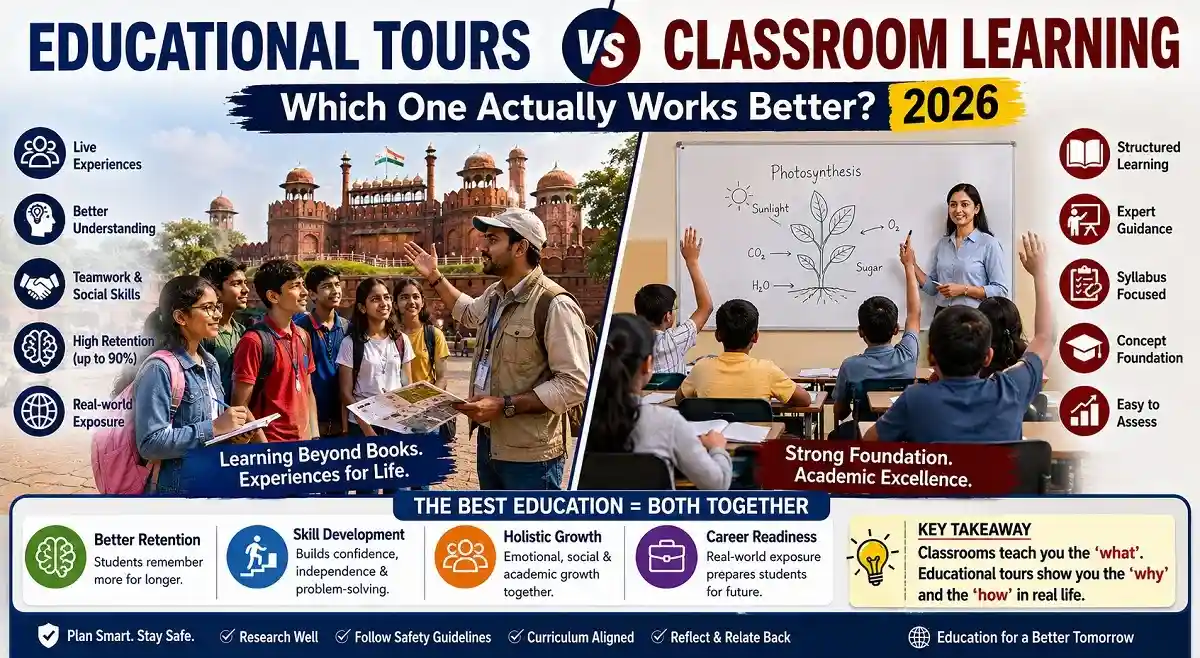
Ask any adult to recall their most vivid school memory. Nine out of ten times, it won’t be a textbook chapter or a classroom lecture. It’ll be a trip — the day they stood inside a fort and felt history through the walls, or the afternoon they watched a river merge at a confluence and finally understood what they’d been reading about for weeks. That is the quiet power of an educational tour.
In a world where learning is increasingly screen-based and attention spans are shrinking, the importance of educational tours has never been greater. These aren’t just fun outings. They are structured, curriculum-linked, research-backed learning experiences that do things classrooms simply cannot. And the evidence for this is substantial.
What Is an Educational Tour?
An educational tour — also called a school excursion, field trip, study tour, or educational travel programme — is a supervised visit outside the classroom, designed to support and extend academic learning. It could be a half-day trip to a science museum in the same city, or a multi-day journey to a historical site, a wildlife sanctuary, a space research centre, or a foreign country.
The defining quality of an educational trip is intent. Educational tourism combines travel activities with learning content, bridging the gap between traditional education and experiential learning by creating non-formal learning environments that enhance students’ intercultural exposure. It’s not sightseeing. It’s learning with your whole body, not just your eyes.
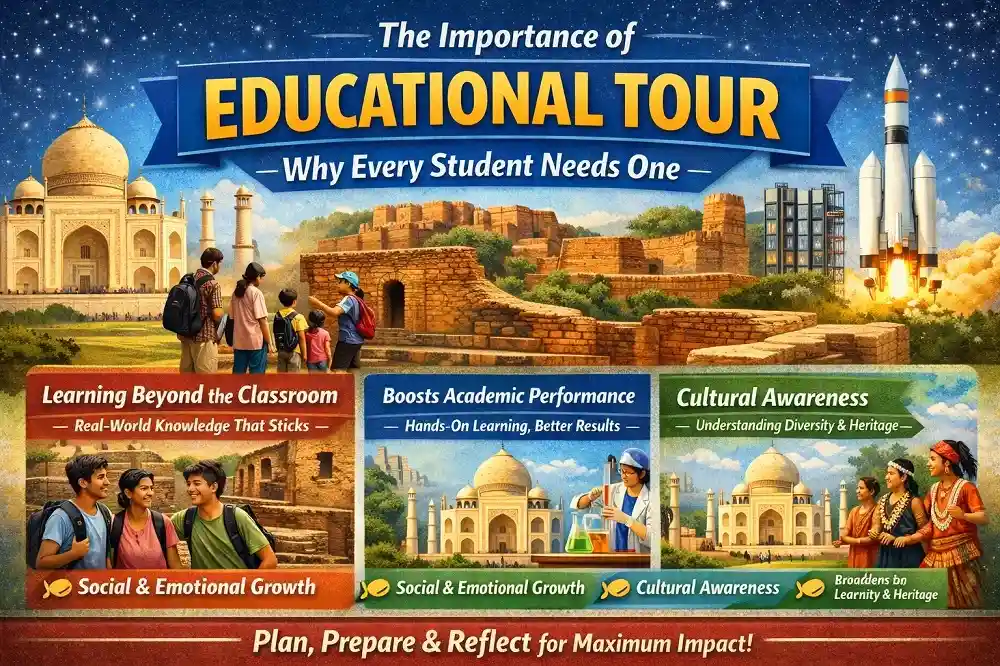
1. Learning Beyond the Classroom: Real-World Knowledge That Sticks
The most fundamental argument for educational tours is also the simplest: people remember what they experience far better than what they read.
Research by Greene et al. (2014) found that students who engaged in educational travel demonstrated an impressive ability to recall facts about what they saw while travelling, showing significantly improved memory retention compared to classroom-only learning.
There is a reason for this. When you visit Nalanda’s ruins in Bihar and stand inside a 1,500-year-old lecture hall, the concept of “ancient Indian universities” is no longer abstract. It has texture, dimension, and weight. Research by Yurtdakal in 2021 suggests that educational travel helps students internalise abstract concepts, bringing textbook knowledge to life.
This is what educators call experiential learning — a theory grounded in the work of John Dewey and later David Kolb, which holds that direct experience is the most effective form of knowledge acquisition. A student excursion turns the experiential learning cycle into reality: the student has a concrete experience, reflects on it, forms understanding, and applies it. All four stages happen naturally on a well-designed educational field trip.
LSI keywords in use: experiential learning, hands-on education, real-world learning, knowledge retention, active learning, place-based learning
2. Improved Academic Performance — Not Just a Nice Feeling
Teachers often sense that field trips help students academically. The research confirms it.
Evidence shows that field trips can enhance students’ academic performance, especially in subjects like science, art, and history, and are particularly beneficial for students from high-poverty backgrounds.
A study by Emilyn Ruble Whitesell found that middle school students who participated in science field trips through the Urban Advantage programme scored better on state science tests than their peers who did not.
The mechanism is straightforward. When a student visits a chemistry lab, a geological formation, or a historical monument as part of their educational school tour, the subject becomes a lived reference point. When that topic appears in a test weeks later, the memory of the experience pulls the answer forward with it. Experiential learning in education creates stronger neural pathways than passive reading — this is not metaphor, it is neuroscience.
For teachers, this translates into practical curriculum alignment. A school learning trip to Jantar Mantar in Jaipur after a unit on ancient astronomy turns revision into recollection. A visit to a textile factory after studying India’s industrial history makes supply chain economics tangible. The classroom lesson and the real-world visit reinforce each other.
3. Social and Emotional Development: Skills No Textbook Can Teach
One of the most underappreciated benefits of educational tours for students is what happens between the lessons — the conversations on the bus, the teamwork during guided activities, the moments of navigating an unfamiliar place together.
Research indicates that educational travel helps students develop teamwork skills and cultural competence — valuable life skills that are difficult to build inside a traditional classroom setting.
Students who go on field trips become more empathetic and tolerant. A study conducted by the University of Arkansas found that students who participated in a field trip to an art museum showed increased empathy, tolerance, and critical thinking skills.
Think about what a student travel programme actually demands of a young person. They must adapt to a new environment, cooperate with peers they may not be close to, follow schedules, make decisions with limited information, and manage their emotions through unfamiliar situations. These are not soft skills — they are the foundational competencies that determine success in higher education and professional life.
Study tours also play a key role in fostering personality enrichment and self-transformation, which is regarded as one of the most important pathways to lifelong learning. The quiet child who speaks up to ask a museum guide a question. The student who helps a classmate navigate a new city. These moments of growth happen on school trips, not during textbook exercises.
Long-tail keywords in use: benefits of educational tours for school students, how field trips help in social development, importance of school excursions in personality development
4. Cultural Awareness and Global Citizenship
India is a country of 28 states, 22 official languages, and thousands of years of layered civilisation. An educational tour within the country alone can be a profound lesson in diversity.
A remarkable 96% of travellers who participated in structured educational travel programmes reported gaining insights into political and social issues that drove them to engage more deeply with their studies.
When students from a city school visit a tribal community in Odisha, or when students from South India tour the Mughal monuments of Uttar Pradesh, they are experiencing something no classroom can replicate: the scale and diversity of their own country. Multiple research studies highlight how educational travel helps students nurture tolerance of differences and appreciate diverse cultures.
This matters more now than at any time in recent memory. In an era of increasing polarisation and digital filter bubbles, the importance of educational travel in building genuinely empathetic, culturally aware young people is significant. A student who has visited a Buddhist monastery, a Hindu temple, a Jain pilgrimage site, and a Sikh gurudwara — as part of a religious studies school trip — understands pluralism not as a concept but as lived experience.
Synonyms and LSI keywords in use: cultural immersion, intercultural understanding, diversity education, global awareness, cultural competence
5. Career Inspiration and Long-Term Academic Motivation
Field trips introduce participants to professional landscapes, inspiring them to align their academic pursuits with long-term goals. A tour of a research facility or a panel discussion with industry experts can provide early exposure to potential career paths.
This is perhaps the most lasting benefit of a well-planned educational excursion — the spark it lights in a student’s imagination. A 14-year-old who walks through the space technology gallery at the Visvesvaraya Industrial and Technological Museum in Bengaluru, or who gets a pre-booked guided tour of ISRO headquarters, might well decide in that moment that aerospace engineering is their future. A student who visits Nalanda’s ancient university ruins and hears about scholars who travelled from China and Korea to study there might develop an entirely new relationship with their own academic ambitions.
Students who participate in educational travel are over 200% more likely to pursue higher education, striving for college or graduate degrees. That is not a minor statistical footnote. That is a life changed by a trip.
Long-tail keywords: how educational trips inspire career choices, do school field trips motivate students, educational tours and higher education aspirations
6. Breaking the Monotony — Engagement and Motivation
Let’s also just say the obvious: school can be boring. Not always, not for everyone — but the routine of a classroom, bell-to-bell, day after day, erodes curiosity in students who might otherwise be deeply engaged learners.
Educational tours make learning more engaging by breaking the monotony of classroom settings and offering real-world applications of academic concepts. Students return to the classroom with a deeper connection and greater motivation for their studies.
Students who travel demonstrate increased motivation and interest in learning, making them more engaged and eager to explore new subjects.
This renewed engagement has a compounding effect. A student who comes back from a heritage learning trip to Hampi or Ajanta Ellora re-enters the classroom energised. They ask questions. They make connections. They bring something to discussions that their peers don’t have. That energy is contagious — and it’s one reason that good teachers fight hard to include co-curricular educational trips in their annual planning despite the logistical challenges.
7. How to Plan an Effective Educational Tour
The benefits of educational tours only fully materialise when the trip is thoughtfully designed. A poorly planned school excursion can waste time, money, and opportunity. Here is what makes the difference:
- Clear learning objectives: Every student field trip should be mapped to specific curriculum goals. What subject knowledge will be built? What skills will be practised?
- Pre-trip preparation: Students who arrive at a site knowing its context get five times more out of the experience. Prepare with readings, discussions, and focused questions.
- Expert local guides: At historical and scientific sites especially, a knowledgeable guide transforms what students absorb. Budget for this.
- Post-trip reflection: Journals, presentations, or classroom discussions after the trip consolidate the learning. Without this, much of the experience fades faster than it should.
- Inclusive planning: Ensure students with different physical abilities, learning needs, and financial backgrounds can participate fully. Field trips are particularly beneficial for students from high-poverty backgrounds — which makes financial inclusion in educational travel planning a matter of equity, not just logistics.
Synonyms in use: student excursion, school outing, heritage tour, nature field trip, science trip, knowledge expedition.
Suggested to Read:
Conclusion: Education That Goes Where Classrooms Cannot
The importance of educational tours is not a matter of opinion or sentiment. It is supported by decades of research across cognitive science, developmental psychology, and educational theory. Quantitative research findings indicate substantial progress across the cognitive, affective, and behavioural domains of learning after educational tourism programmes.
Students who learn by doing, seeing, touching, and experiencing retain more, engage more deeply, develop stronger social skills, and emerge more curious than those who learn only from books and screens. A well-planned educational field trip is one of the most powerful pedagogical tools available to any school — and it costs far less than the lifelong impact it creates.
The old Chinese proverb that educators love to quote puts it best: “I hear and I forget. I see and I remember. I do and I understand.” Every educational tour is an act of understanding. And understanding, as opposed to mere memorising, is what education is actually for.
Key Takeaways
- Educational tours improve memory retention and academic performance through experiential learning
- School field trips develop teamwork, empathy, tolerance, and cultural awareness
- Educational travel inspires career choices and increases motivation for higher education
- Students from all backgrounds benefit — and inclusive planning is essential
- Pre-trip preparation and post-trip reflection double the educational value of any excursion
- India offers world-class destinations for every subject: history, science, ecology, religion, art, and governance