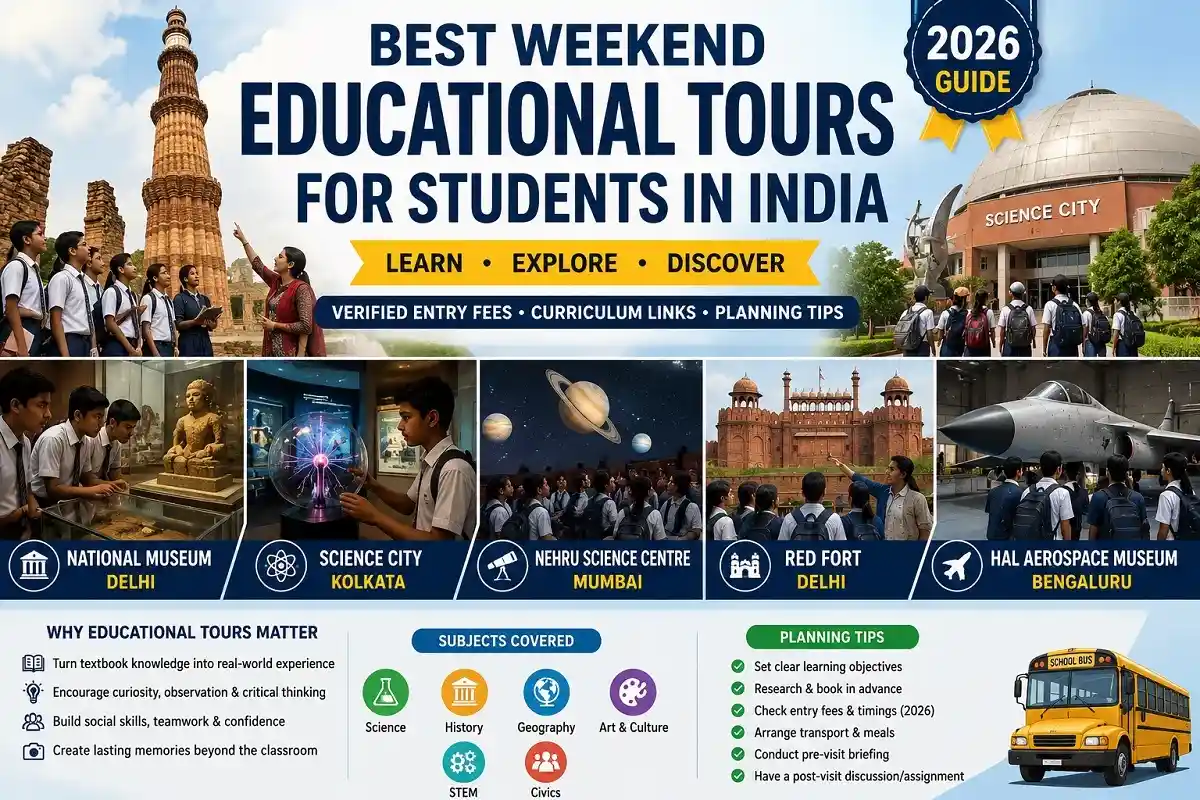
India is not just a travel destination. It is a classroom without walls. Where else can you stand at the ruins of a university that taught students from China, Korea, and Persia in the 7th century — and then drive an hour to a space research centre that put a mission in Mars orbit on a fraction of NASA’s budget? History, science, art, ecology, philosophy, governance — India teaches all of it, and it teaches it in a way no textbook ever quite matches.
Educational trips in India work because the learning is embedded in the experience. You don’t read about Mughal architecture — you stand inside it and feel the geometry. You don’t just study ancient astronomy — you climb the giant stone instruments at Jantar Mantar and understand why they still work. This guide covers the best places across India for learning and educational travel, organised by what each destination teaches best.
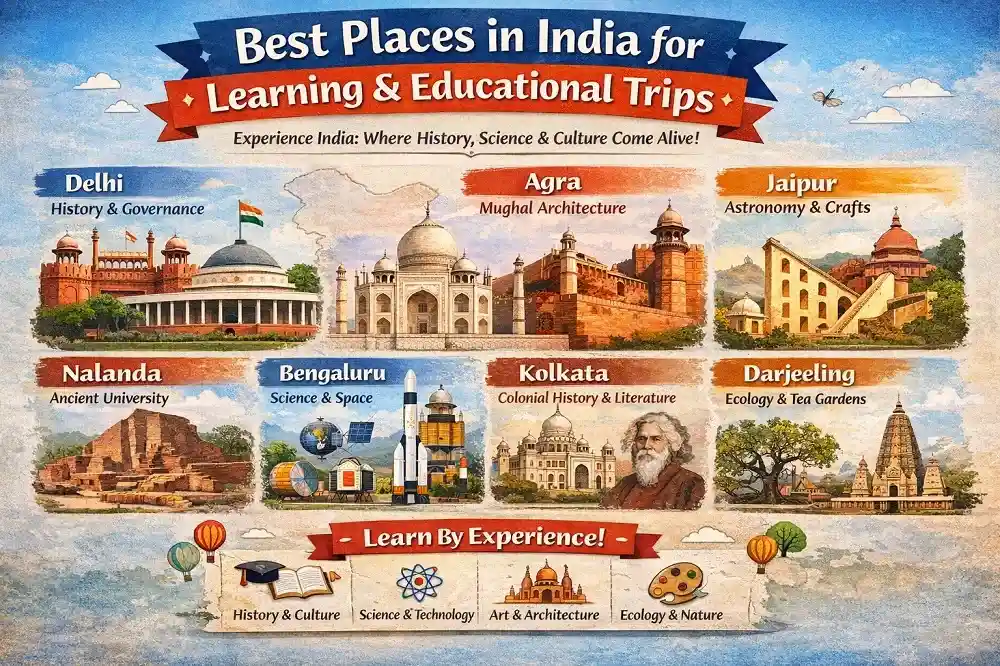
1. Delhi — History, Governance and the Making of a Nation
No city in India packs more learning into a single visit than Delhi. It has been the seat of power through multiple empires — the Delhi Sultanate, the Mughal Empire, and now modern India’s democracy — and every era left something behind that can be walked through and understood.
What to learn here:
- Red Fort (Lal Qila): A UNESCO World Heritage Site built in 1648 by Mughal Emperor Shah Jahan. The fort is where India’s Prime Minister addresses the nation on Independence Day every year — connecting living history to current civics in one monument. Entry fee: ₹50 for Indians, ₹600 for foreign nationals.
- Qutub Minar: Built in 1193 CE, it is the tallest brick minaret in the world and the centrepiece of the Indo-Islamic architectural tradition. For students studying medieval India or architecture, this is primary-source learning. Entry fee: ₹40 for Indians.
- National Museum (Janpath): One of the largest museums in India, it houses artefacts spanning the Indus Valley Civilisation, the Mauryan period, the Mughal era, and into the colonial period. A single morning here covers 5,000 years of Indian history with actual objects — not replicas.
- Parliament House and India Gate: For students studying political science, civics, or modern history, a visit to the Rashtrapati Bhavan area, India Gate (a World War I memorial), and the Parliament complex gives a tangible understanding of Indian governance and democratic heritage.
- Raj Ghat: The simple black marble memorial to Mahatma Gandhi at the site of his cremation is one of the most quietly powerful places in Delhi. For anyone studying India’s independence movement, this is not optional.
Best for: History, political science, architecture, civics, religious studies.
2. Agra — Mughal Architecture and the Science of Beauty
Agra is not just about the Taj Mahal. It is about understanding what a civilisation can achieve when engineering, mathematics, art, and spirituality converge.
- Taj Mahal: Built between 1631 and 1653 by Emperor Shah Jahan in memory of his wife Mumtaz Mahal, it employed 20,000 workers and used white marble quarried from Makrana, Rajasthan. The inlay work uses semi-precious stones from across Asia — turquoise from Tibet, lapis lazuli from Afghanistan, carnelian from Arabia. For students of architecture, material science, or art history, there is no richer single structure in India. Entry fee: ₹50 for Indians, ₹650 for foreign nationals, with an additional ₹200 for the inner mausoleum.
- Agra Fort: A UNESCO World Heritage Site started by Emperor Akbar in 1565 and completed in 1574. Its layered construction — each emperor added to it — makes it a living timeline of Mughal architecture and power. The view of the Taj Mahal from its ramparts is also a useful lesson in how Mughal rulers staged visual power.
- Fatehpur Sikri: 40 km from Agra, this entire city was built by Akbar in red sandstone in 1571 and mysteriously abandoned shortly after, reportedly due to water scarcity. For students studying urban planning, environmental history, or Mughal culture, the intact ruins of a planned imperial capital are extraordinary.
Best for: Art history, architecture, medieval history, engineering principles, materials science.
3. Jaipur — Astronomy, Rajput Architecture and Living Craft
Jaipur surprises people. Most visitors expect palaces and forts — and they get them — but the city also hosts one of the most sophisticated pre-telescopic astronomical observatories ever built, and a living craft tradition that turns shopping lanes into applied anthropology lessons.
- Jantar Mantar: Built in 1728 by Maharaja Sawai Jai Singh II, this UNESCO World Heritage Site contains the world’s largest stone sundial (the Samrat Yantra) and a collection of astronomical instruments that can still accurately predict solar and lunar eclipses, the positions of stars, and the summer solstice. For students of astronomy, mathematics, or the history of science, Jantar Mantar is jaw-dropping. Entry fee: ₹50 for Indians.
- Amber Fort: Built in the late 10th century and expanded significantly under Raja Man Singh I in 1592, this hilltop fort is a study in Rajput military architecture and Hindu-Mughal aesthetic fusion. The Sheesh Mahal (Mirror Palace) — a room lined with thousands of small mirrors that reflect a single candle into a starfield — is a lesson in pre-industrial optics.
- City Palace Museum: Part of the still-occupied royal residence of the Jaipur royal family, the museum section has an outstanding collection of Rajput weaponry, astronomical instruments, textiles, and manuscripts that give context to Rajasthan’s political and cultural history.
Best for: Astronomy, mathematics, architecture, Rajput history, craft traditions.
4. Nalanda, Bihar — The World’s Oldest University
This is one of the most intellectually significant sites in India — and one of the most undervisited.
The Archaeological Site of Nalanda Mahavihara is located in the state of Bihar. It comprises the archaeological remains of a monastic and scholastic institution dating from the 3rd century BCE to the 13th century CE. Nalanda stands out as the most ancient university of the Indian Subcontinent — it engaged in the organised transmission of knowledge over an uninterrupted period of 800 years.
At its peak, Nalanda was home to over 10,000 students and 2,000 teachers from across Asia — including students from China, Korea, Japan, Persia, and Tibet. It taught Buddhist scripture, philosophy, logic, medicine, mathematics, astronomy, and grammar.
The university was destroyed in the 12th century by Bakhtiyar Khilji, who burned its library — reportedly a collection so vast it burned for months. The site was excavated by the Archaeological Survey of India from 1915 and was inscribed as a UNESCO World Heritage Site in 2016.
Walking through the ruins — the lecture halls, dormitories, stupas, and meditation cells — is an experience that puts the scale of ancient Indian intellectual life into physical perspective. The Nalanda Archaeological Museum nearby holds sculptures, coins, and manuscripts recovered from the site.
Entry fee: ₹15 for Indians, ₹200 for foreign nationals. Best visited in combination with Bodh Gaya (80 km away) and Rajgir (14 km away).
Best for: History of education, Buddhism, ancient philosophy, archaeology, comparative religion.
5. Bengaluru — Science, Technology and India’s Space Age
Bengaluru is India’s technology capital, and for students interested in science, engineering, and innovation, it offers institutional visits that simply don’t exist elsewhere in the country.
- Visvesvaraya Industrial and Technological Museum (VITM): Inaugurated on 14 July 1962 by Prime Minister Jawaharlal Nehru and named in honour of Bharat Ratna Sir M. Visvesvaraya, VITM is among the most visited science museums in India, receiving over a million visitors annually. Its galleries cover space technology (with ISRO models and mission simulations), biotechnology, engines, electronics, and an electro-technical gallery with live demonstrations. The Space Technology Gallery — inaugurated in 2017 — is the first science gallery in India dedicated entirely to space technology, with interactive and immersive exhibits on ISRO missions. Entry fee: ₹100 per person.
- ISRO Headquarters (Indian Space Research Organisation): Visitors can register on the ISRO website to visit ISRO headquarters. Each slot accommodates up to 25 visitors, with a nominal fee of ₹100 per person. The tour includes models of PSLV, GSLV, Chandrayaan, Mangalyaan, and the Gaganyaan human spaceflight programme, along with interactive kiosks on various ISRO missions. Pre-booking is essential and slots fill quickly.
- HAL Heritage Centre and Aerospace Museum: India’s oldest aerospace company, Hindustan Aeronautics Limited, runs a museum in Bengaluru displaying vintage aircraft, jet engines, missiles, and the history of Indian aviation manufacturing. One of the few places in India where you can walk around full-scale aircraft, including a Marut — India’s first domestically designed fighter jet.
Best for: Science, engineering, space technology, aerospace, applied physics.
6. Kolkata — Colonial History, Literature and the Bengal Renaissance
Kolkata (Calcutta) offers a different kind of education — the intellectual and social history of a city that was the centre of British India for nearly 150 years, and simultaneously the birthplace of the Bengal Renaissance.
- Indian Museum: The oldest and largest museum in India, founded in 1814. Its collections span Egyptian mummies, Indus Valley artefacts, Mughal paintings, Himalayan fossils, and Buddhist sculptures from across the subcontinent. For breadth of subject matter, nothing in India matches it.
- Victoria Memorial: Built between 1906 and 1921 as a tribute to Queen Victoria and now a museum of colonial-era India, it holds paintings, manuscripts, weapons, and photographs that document British India’s administrative and social history. A complex place to visit — it prompts important conversations about empire, architecture, and national identity.
- Rabindranath Tagore’s Jorasanko Thakur Bari: The ancestral home and birthplace of Rabindranath Tagore — Asia’s first Nobel Laureate in Literature (1913) — is now a museum. For students of literature, Indian philosophy, or the Bengal Renaissance, this is as close to primary-source learning as it gets.
Best for: Colonial history, Indian literature, archaeology, art history, anthropology.
7. Darjeeling — Ecology, Tea Economy and UNESCO-listed Railway Engineering
Darjeeling is a different category of educational destination — one that teaches through ecology, economics, and engineering in equal measure.
Students gain an understanding of agriculture and economics while visiting Darjeeling’s tea farms — learning the production and processing of tea and how India’s tea industry supports international trade.
The Darjeeling Himalayan Railway, nicknamed the “Toy Train,” is a UNESCO World Heritage Site. It guides students about the history of Indian railways during the colonial period, railway engineering, and the effects of high-altitude transportation infrastructure.
The Padmaja Naidu Himalayan Zoological Park, at an altitude of 7,000 feet, houses endangered Himalayan species including the snow leopard, red panda, and Himalayan wolf — offering practical lessons in biodiversity conservation and high-altitude ecosystems.
Best for: Environmental science, ecology, economics, railway and engineering history, biodiversity.
8. Bodh Gaya, Bihar — Buddhism, Philosophy and Pilgrimage Studies
Located about 80 km from Nalanda, Bodh Gaya is the site where Siddhartha Gautama attained enlightenment under the Bodhi Tree. The Mahabodhi Temple complex is a UNESCO World Heritage Site and one of the four most sacred sites in Buddhism globally. For students of world religion, philosophy, or Asian history, Bodh Gaya is irreplaceable. Monasteries from Japan, Tibet, China, Sri Lanka, Thailand, and Bhutan exist side by side here — making it one of the most internationally diverse religious sites in India.
Best for: Religious studies, Buddhist philosophy, Asian history, comparative religion.
Practical Planning Tips
- Best time for most destinations: October–March. North Indian summers (April–June) make outdoor sites uncomfortable for school groups.
- Book institutional visits in advance: ISRO headquarters and VITM group visits require prior registration. Don’t leave this to the last minute.
- Pair destinations: Nalanda + Bodh Gaya + Rajgir makes a natural 2–3 day Bihar circuit. Delhi + Agra + Jaipur is the Golden Triangle. Bengaluru’s museums can fill 2 full days.
- Local guides matter enormously: At Nalanda, Fatehpur Sikri, and Red Fort especially, an authorised ASI guide transforms a walk through ruins into a living history lesson. Budget ₹400–₹800 per guide per site.
- Subject-specific mapping: Teachers planning curriculum-linked trips should map the subject angle before booking. Jantar Mantar for mathematics and astronomy. Nalanda for history of education. VITM for science and ISRO for technology.
Quick Reference: Places by Subject
| Subject | Best Destinations |
|---|---|
| Ancient History | Nalanda, Agra (Fatehpur Sikri), Delhi (Qutub Minar) |
| Medieval/Mughal History | Delhi, Agra, Jaipur |
| Science & Technology | Bengaluru (VITM, ISRO, HAL), Darjeeling (Railway) |
| Astronomy & Mathematics | Jaipur (Jantar Mantar) |
| Religion & Philosophy | Bodh Gaya, Varanasi, Delhi |
| Ecology & Environment | Darjeeling, Kerala backwaters |
| Colonial History | Kolkata, Delhi, Agra |
| Literature & Arts | Kolkata (Tagore’s home), Jaipur (craft traditions) |
| Economics & Agriculture | Darjeeling (tea gardens), Punjab (agriculture) |